A used test handler that cannot dock to your tester is worth nothing on your floor. Ask anyone who has bought one that did not fit. The machine arrives, the specs looked right on paper, and then the docking hardware turns out to be wrong. That scenario drives everything in this guide.
Accuracy figures, throughput claims, and platform reputations matter less than whether the machine will physically connect, run your package, and reach production without months of adaptation.
The sections below follow the sequence a real purchase follows: compatibility first, equipment type second, cost third, verification last.
Semiconductor Test Handlers: Compatibility Comes Before Everything Else
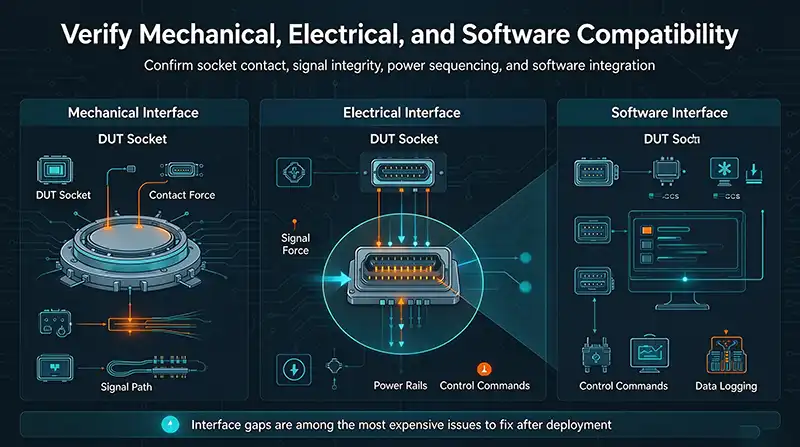
The most common reason a used semiconductor test handler gets returned is docking failure. The datasheet says the platform supports BGA. It does not say whether the docking direction matches the test head already installed, whether the HIFIX height lines up, or whether the site count fits the contactor layout in use. For semiconductor test handlers, these details decide whether the machine ever leaves the loading dock.
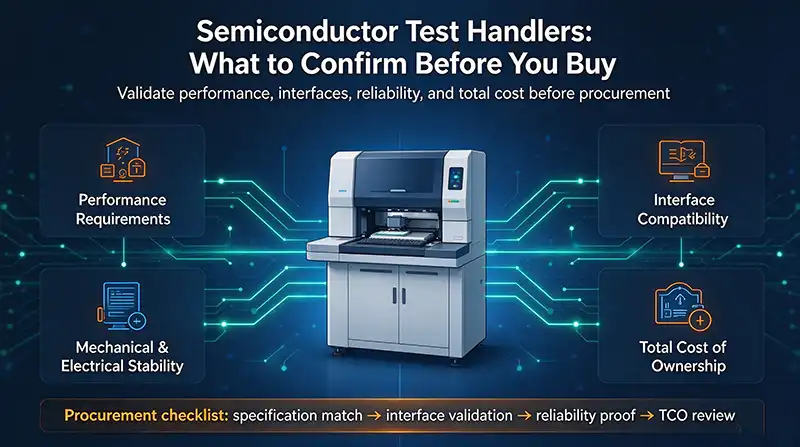
Four items determine whether a semiconductor test handlers can run at all.
| Item | What to Confirm | What Happens When It Does Not Match |
|---|---|---|
| Docking direction | Top-load, bottom-load, or side-dock matches your test head | Adapter hardware, weeks of delay |
| HIFIX and contactor | Alignment and height match your socket | New interface required |
| Site count | Within your ATE parallel test limit | Contactor layout mismatch |
| Communication | Bin signals, recipe control, SECS/GEM compatibility | Software modification required |
Docking direction is the item buyers overlook most often. Top-load, bottom-load, and side-dock configurations are not interchangeable. A handler built for one orientation will not fit a test head built for another.
HIFIX and contactor alignment determines whether the mechanical interface works. A mismatch here means purchasing new interface hardware, and that cost frequently exceeds the price gap between two candidate machines.
Site count is capped by the ATE, not the handler. A handler rated for sixteen sites runs eight if the tester can only measure eight per insertion.
Communication compatibility covers bin signals, recipe control, and factory interfaces. SECS/GEM and host link formats must align with the ATE software already in place.
Send this information for a compatibility review:
ATE brand and platform (Advantest V93000, Teradyne UltraFLEX, Cohu Diamond, Chroma, or another)
Test head model if known
Docking direction and HIFIX model
Package family, dimensions, input and output media
Required temperature range
Target site count per insertion
Equipment Type Determines What the Machine Can Run
Throughput is a secondary concern. A fast handler built for the wrong package flow is still the wrong machine.
| Type | Packages | Example Platforms | Primary Benefit | Primary Constraint |
|---|---|---|---|---|
| Gravity | DIP, SOP, SOIC, TO-series, power discretes | Cohu Rasco SO1000, MT9928 | Lowest cost per position | Leaded packages only |
| Turret | LED, SMD, discretes | ASM Turret Series, Hon Precision | Overlapping test, vision, sort stations | Low changeover flexibility |
| Pick-and-Place | BGA, QFP, CSP, LGA | Cohu MATRiX, MT9510 | Placement control, flexibility | Highest mechanical complexity |
| Strip / Film-Frame | QFN strips, leadframe products | Cohu MCT FH-1200, Rasco Jaguar | Parallel contact, fewer handling steps | Depends on exact frame dimensions |
Gravity Handlers
Parts enter from tubes and travel along a track to the test site. The Cohu Rasco SO1000 handles tubes sized 3.5 mm to 15 mm and runs up to 14,400 UPH. Track geometry for leaded packages has been refined over decades. Jam rates are low. For long-running leaded product lines, gravity remains the economical choice.
Turret Handlers
A rotating platform carries parts through a ring of stations. LED and discrete production runs on turrets almost exclusively. Test, vision, and sorting overlap around the rotation. Flexibility is limited. Changing products means swapping station modules.
Pick-and-Place Handlers
A nozzle lifts a part from a tray and places it on the socket with controlled force. BGA, QFP, CSP, and LGA packages require this placement control. The MT9510 XP handles devices from 2 mm × 2 mm up to 70 mm × 70 mm and supports up to 16 contact sites. This type is the most flexible and the most mechanically complex.
Strip and Film-Frame Handlers
Parts remain on the leadframe or film frame through test. Several devices can be contacted in one step. Everything depends on frame dimensions and pitch matching the machine precisely.
Site Count and Changeover Shape Real Cost
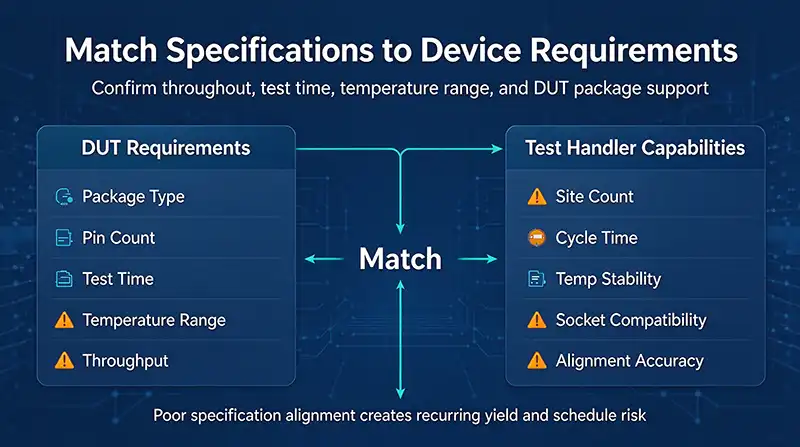
Two figures describe cost per device better than any headline throughput number.
Site count sets how many devices the tester measures per insertion. The MT9510 x16 runs up to 5,300 UPH with 0.04 s virtual index time in x16 mode. The ceiling comes from the ATE.
Changeover time consumes production hours when switching between package types. The MT9510 requires 20 minutes for one person to convert package styles, with no adjustments required afterward.
| Metric | Why It Matters | What to Verify |
|---|---|---|
| Site count | Sets tester cost per device | Within ATE limit, contactor layout matches |
| Changeover time | Consumes production hours | Measured on the actual unit |
| UPH under real test time | Reflects actual output | Not brochure peak |
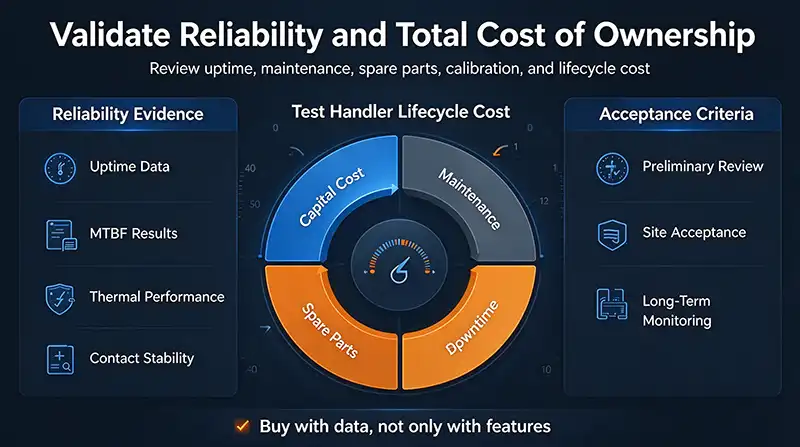
| Jam recovery and MTBF | Determines real uptime | Maintenance history, spare availability |
Temperature Capability Needs Specifics, Not Labels
Tri-temperature handlers run cold, ambient, and hot. Automotive and industrial parts typically require this. The MT9510 offers tri-temp from -55°C to +175°C with test site accuracy of ±3°C and stability of ±0.5°C.
The parameters that decide whether test results are valid:
| Parameter | Why It Matters | MT9510 Reference |
|---|---|---|
| Actual range | Covers your product requirement | -55°C to +175°C |
| Stability | Affects test validity | ±0.5°C |
| Accuracy | Affects grading | ±3°C |
| Cooling method | Drives operating cost | LN₂: 18 l/h cold operation, 33 l/h cool-down |
Change Kits Decide Whether the Machine Runs Next Week
On the used market, the installed change kit often separates a machine that enters production quickly from one that sits idle for months. The MT9510 uses conversion kits for QFP, BGA, μBGA, PLCC, TSSOP, CSP, QFN, PGA, LGA, and MCM packages.
Price the handler and the kit separately. The numbers are rarely close.
| Kit Category | Contents | What to Inspect |
|---|---|---|
| Handling parts | Tracks, trays, nests, nozzles, guides | Wear level, spare sets included |
| Test interface | Contactor, HIFIX, docking hardware | Alignment, site count, ATE fit |
| Software and options | Recipes, thermal modes, vision, output modules | License status, installed modules |
Used Equipment Verification
Before money changes hands, verify each of these.
| Item | What to Check | Risk |
|---|---|---|
| Identity | Full model, serial number, year | Configuration does not match description |
| Maintenance history | Service records, failures, replaced parts | No records, unknown condition |
| Change kit | Completeness, wear, spares | Missing parts block production |
| Thermal system | Actual performance test, LN₂ status | Performance degraded below spec |
| Software | Version, license status, installed modules | License not transferable |
| Included spares | Tooling, consumables, wear parts | Affects routine maintenance |
What to Send When Requesting a Quote
| Information | Example |
|---|---|
| ATE brand and model | Advantest V93000, Teradyne UltraFLEX, Cohu Diamond |
| Docking direction and HIFIX | Top-load, bottom-load, or side-dock; HIFIX model |
| Package and media | QFN, BGA, SOP; tray, tube, or strip input/output |
| Temperature range | Ambient, hot, cold, or tri-temp; specific window |
| Site count | Target parallel test count |
| Throughput target | Required UPH |
| Destination | Shipping and installation planning |
Frequently Asked Questions
What is a test handler?
A test handler is automation equipment that loads packaged devices, conditions them to the required temperature, presents them to the ATE contactor, and sorts them by test result. It does not perform electrical measurement itself.
How do I know if a used handler is compatible with my ATE?
Confirm four points: docking direction and test head type, HIFIX and contactor interface, site count per insertion, and communication protocol. If any of these do not match, the handler will not deploy without additional hardware or software changes.
What is the difference between a test handler and an ATE system?
The ATE applies electrical test signals and measures the device. The handler transports the device, controls its temperature, positions it at the contact interface, and sorts it by result. Both must be mechanically and electronically integrated.
What is a tri-temperature test handler?
A tri-temperature handler conditions devices for testing at cold, ambient, and hot temperatures. Confirm the required range, soak method, thermal stability, device power dissipation, and the utilities used by the actual system.
Why is site count so important for test cost?
Site count determines how many devices the ATE can test per insertion. A handler with 16 sites at 5,300 UPH can produce lower cost per device than a 4-site handler at 8,000 UPH, because the tester amortizes across more devices per cycle. Site count is limited by both handler and ATE capability.
What should be checked before buying a used test handler?
Verify the complete model, serial number, year, handler type, installed change kit, temperature system, test sites, contactor interface, software version, licenses, maintenance history, and included spares. The change kit is often more valuable than the handler itself.
Are contactors and change kits included with the machine?
Never assume. The quotation should list the handler, installed modules, change kits, HIFIX or docking hardware, contactors, trays, tools, software, and spare parts that are supplied. Missing change kits are the most common hidden cost on used test handlers.
What information is needed to quote a used test handler?
Provide the preferred manufacturer and model, package family, input and output media, ATE platform and docking details, temperature range, site count, production target, required condition, and destination.
How long does it take to install and qualify a used handler?
Installation and qualification typically run from several days to several weeks, depending on docking complexity, change kit completeness, and site acceptance testing requirements. Missing change kits or docking mismatches can extend this considerably.
Can a handler test more sites than the ATE supports?
No. Site count is bounded by the ATE's parallel test capability. The handler can only present as many devices as the tester can measure in one insertion.
What is the difference between a handler and a prober?
A prober handles wafer-level testing, positioning a probe card against dies on a wafer. A handler handles packaged devices after assembly. Both interface with ATE but operate at different stages of the semiconductor manufacturing flow.
What affects changeover time between package types?
Track or nest replacement, nozzle changes, recipe updates, temperature profile adjustment, and output media reconfiguration. The MT9510 requires 20 minutes for one person to convert package styles. Confirm actual changeover time with the specific unit, not the platform datasheet.
Selection Checklist
Type Matching
Determine package type and input/output media
Confirm required temperature range (ambient/hot/cold/tri-temp)
Evaluate target throughput and site count requirements
Match handler type to package characteristics
Compatibility Confirmation
Confirm ATE brand and model
Verify docking direction and test head orientation
Confirm HIFIX and contactor interface type
Validate site count within ATE capability
Check communication protocol compatibility
Equipment Evaluation
Verify serial number, year, and maintenance records
Assess change kit completeness and wear condition
Confirm software licenses and installed options
Check actual thermal system performance
Confirm included spares and tooling
Quotation and Acceptance
Request itemized quotation (main unit, kits, interface, software, spares)
Confirm shipping and installation plan
Plan on-site acceptance testing
Clarify after-sales support and spare parts supply
The handler decides what the tester gets to measure and how quickly. It does not measure anything itself, but its type, site configuration, thermal capability, and docking compatibility determine whether the ATE delivers full value.
On the used market, the risks sit in the details that never made it onto the datasheet: docking direction, HIFIX interface, change kit completeness. Verifying those details before purchase matters more than comparing throughput figures.
A well-matched used handler can be running production within weeks. A poorly matched one costs more than its price in adapters, waiting time, and idle hours. The difference comes down to how carefully the fit was verified beforehand.