In the semiconductor back-end packaging and testing process, the automatic dicing saw is the core equipment for wafer dicing. For manufacturers planning capacity or upgrading production lines, the equipment quote is often the first thing they focus on—but the variables behind the price are far more complex than "how much does one cost."
Prices for automatic dicing saws span an enormous range. Entry-level laboratory equipment may cost as little as $3,900 to $6,900, while fully automatic models for mass production can reach $64,000**, with some high-end dual-spindle machines exceeding **$93,000. A used Kulicke and Soffa 7100AD can sell for as little as $337.50, but such equipment typically has cosmetic damage and comes without a warranty. Behind this huge spread lies a series of differences in technical specifications, configuration levels, and application scenarios.
Spindle Count and Worktable Size: The First Threshold of Price Stratification
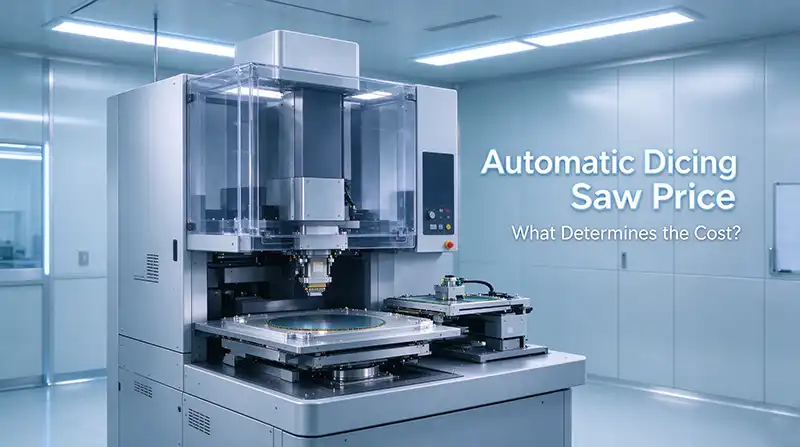
The most basic classification of automatic dicing saws is based on spindle count. A single-spindle model can only cut in one direction per load, while a dual-spindle Dicing Saw model can complete both longitudinal and transverse dicing in a single cycle, nearly doubling throughput. For R&D lines or small-batch production lines with modest monthly capacity requirements, a single-spindle machine is sufficient, and the initial investment is lower. For users in mass production environments, however, dual-spindle models command a significantly higher purchase price but drastically shorten processing time per wafer, resulting in a shorter payback period.
Worktable size also directly affects price. Machines supporting 6-inch wafers differ fundamentally from those supporting 8-inch or 12-inch wafers in mechanical structural rigidity, travel range, and spindle power requirements. For example, an automatic dicing saw supporting 10-inch wafers typically features a 60,000 RPM air-bearing spindle, 1.2kW output power, and a fully closed-loop linear motor drive system. The combination of these configurations pushes equipment cost far above that of laboratory-grade small-format machines.
Spindle and Motion Platform: Precision Determines the Premium
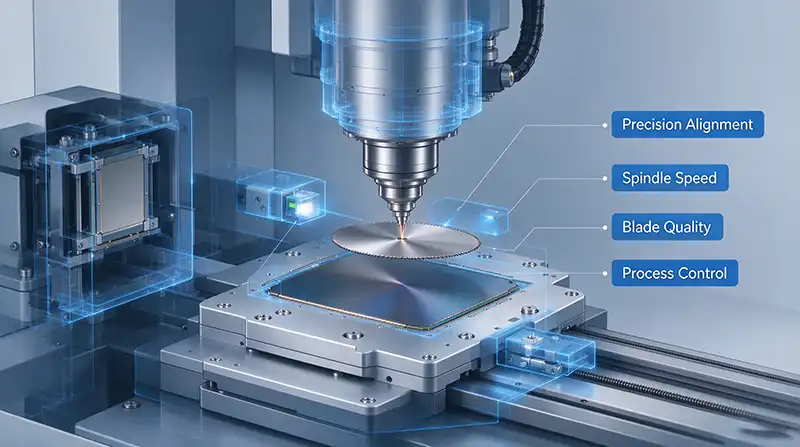
The spindle is the "heart" of a dicing saw, and its type and performance are key to price stratification. Conventional mechanical bearing spindles cost less but fall short in vibration control and service life at high speeds. Air-bearing spindles achieve higher rotational accuracy and thermal stability, making them virtually standard in high-precision dicing applications. A typical production-grade automatic dicing saw spindle can reach 60,000 RPM with rotational accuracy controlled at the 1-micron level.
Motion platform resolution also affects pricing. High-end models are equipped with linear motors and fully closed-loop control systems, with X-axis minimum step as fine as 1 micron and Y-axis and Z-axis resolution reaching 0.1 micron. This level of positioning accuracy is critical for dicing narrow streets, small dies, or brittle materials. If the application only involves cutting larger power devices or ceramic substrates, sub-micron precision is not urgent, and a mid-range configuration is sufficient—there is no need to pay for precision you won't use.
Dicing Technology Route: The Trade-off Between Mechanical Blades and Lasers
Traditional mechanical blade dicing has a lower entry barrier, with mature equipment structures and a well-established maintenance ecosystem. But the hidden costs of mechanical dicing cannot be ignored: blades are consumables, spindle bearings gradually wear at high speeds and require periodic rework or replacement. In addition, mechanical dicing requires a continuous supply of high-purity deionized water for cooling and cleaning, and there are risks of blade wobble and die chipping during the cut.
The initial purchase price of laser stealth dicing and laser ablation systems is typically 2 to 3 times that of comparable mechanical equipment. But the return on this premium lies in: zero blade consumption, zero deionized water consumption, zero kerf loss, and significantly higher yield when processing brittle materials such as silicon carbide, gallium nitride, and sapphire. For users processing expensive compound semiconductors or ultra-thin memory wafers, the total cost of ownership of a laser system may actually be lower than a mechanical solution. What's needed during selection is a full life-cycle cost calculation, not just the number on the quote.
Automation Level and Process Support
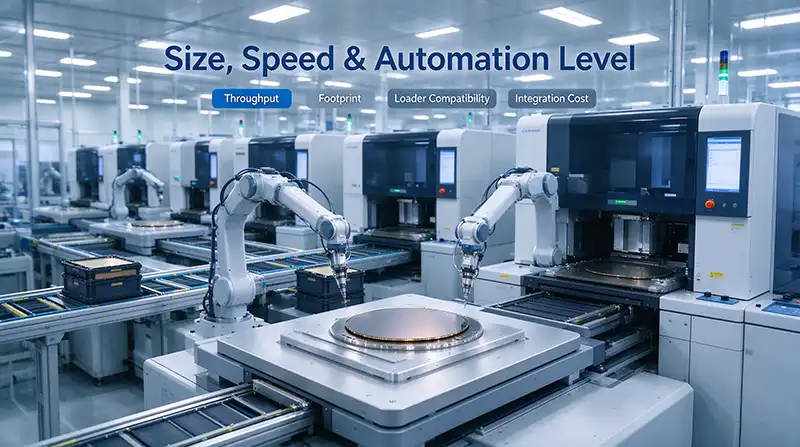
The meaning of "automatic" varies greatly across different models. Basic automation may only include automatic alignment and programmed dicing paths; full automation covers automatic loading/unloading, blade mark inspection, blade breakage monitoring, and multi-material automatic alignment. Automatic loading/unloading systems particularly affect the feasibility of unmanned production—machines equipped with cassette elevators and robotic transfer can minimize manual intervention, making capacity utilization at night and on weekends completely different.
The completeness of process support is also reflected in the total price. Whether spindle cooling systems, dicing water circulation units, blade mark inspection cameras, and non-contact height sensors are included—these options, when added up item by item, can raise the total equipment price well above the bare machine quote. During procurement, always confirm the configuration scope covered by the quote to avoid subsequent budget additions.
Brand and After-Sales Service: The Invisible Cost
Equipment from top international brands (such as DISCO and Kulicke & Soffa) holds relatively high resale value in the secondary market, with mature technical support and spare parts supply systems—but new machine prices are correspondingly high. Domestic equipment manufacturers have made significant progress in cost-effectiveness in recent years, often offering more competitive quotes for equivalent specifications, but they are still catching up in high-end process validation and global service networks.
For mass production users, after-sales response speed and spare parts supply cycles are more important variables than the initial purchase price. If a machine with a failed spindle waits weeks for overseas spare parts, the production loss can far exceed the value of the equipment itself. When selecting suppliers, local service capability and committed response times should be included in the evaluation system.
Price Range Reference Table
The table below summarizes typical price ranges and applicable scenarios for different types of automatic dicing saws, serving as a preliminary selection reference. Actual quotes will fluctuate based on configuration, brand, region, and procurement channel.
| Equipment Type | Typical Price Range (USD) | Core Features | Applicable Scenarios |
|---|---|---|---|
| Laboratory/Entry-level Single-spindle | 3,900 – 6,900 | Small worktable, basic automation, mechanical spindle | R&D prototyping, small-batch ceramic/glass dicing |
| Mid-range Single-spindle Production | 25,000 – 45,000 | 8-inch worktable, air-bearing spindle, semi-automatic loading | Power devices, LED chip mass production |
| Dual-spindle Fully Automatic Production | 64,000 – 93,000+ | Dual spindles, fully automatic loading, blade mark inspection, closed-loop control | 12-inch wafers, memory, logic chip mass production |
| Laser Stealth Dicing System | 120,000 – 250,000+ | Zero blade consumption, no deionized water, high yield on brittle materials | SiC/GaN, sapphire, ultra-thin wafers |
| Used Equipment (condition-dependent) | 300 – 20,000 | No warranty or short-term warranty, uncertain spare parts supply | Temporary capacity supplementation on a limited budget |
A Pragmatic Framework for Procurement Decisions
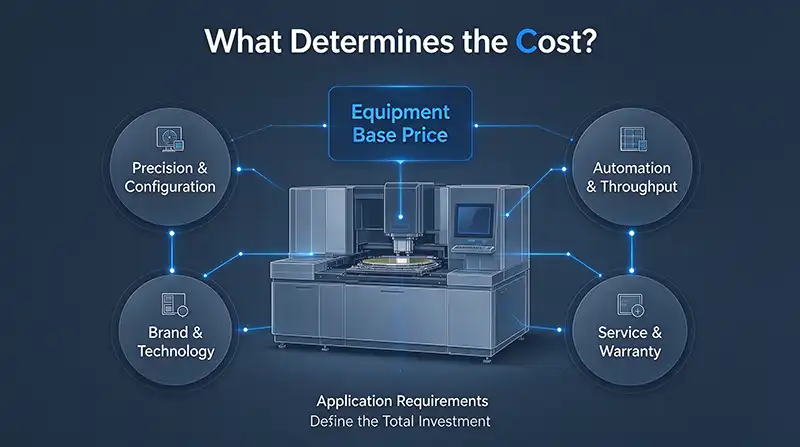
Before requesting quotes, it's advisable to clarify several core parameters: target wafer size, material type, daily/monthly capacity requirements, dicing precision specifications, whether brittle materials are involved, and whether fully automatic loading/unloading is needed. Once these requirements are prioritized, the equipment price range will naturally emerge.
Do not use "lowest price" as the basis for your decision. A machine with a low quote but high blade consumption, frequent spindle rework, and unstable yield may cost more over three years than a machine with a higher initial quote but stable operation. An automatic dicing saw is a production tool, and its value should be measured by cost per good die, not by the number on the purchase invoice.
Frequently Asked Questions
Q1: How much price difference is there between an automatic dicing saw and a semi-automatic one?
Semi-automatic models typically require manual loading and alignment, with prices ranging from about $15,000 to $30,000. Fully automatic models, with added robotic loading/unloading, automatic alignment, and inline inspection, usually cost double or more. If daily capacity is below 50 wafers, a semi-automatic machine may offer better value.
Q2: What configuration is needed for dicing silicon carbide wafers, and what does it cost?
Silicon carbide is extremely hard, placing stringent demands on spindle power and blade life. It's recommended to choose a machine with an air-bearing spindle of 60,000 RPM or higher, output power above 1.2kW, and a high-rigidity worktable. Mechanical dicing solutions cost about $45,000 to $80,000, while laser stealth dicing systems exceed $120,000. Specific selection depends on street width and chipping tolerance.
Q3: Is it worth buying a used automatic dicing saw?
It depends on capacity urgency and budget flexibility. Used equipment may cost only 10%–30% of a new machine, but spindle life, spare parts supply, and precision degradation are the main risks. Before purchasing, request spindle operating hours and the most recent maintenance record, and arrange an on-site dicing test. For mass production, prioritize refurbished models with a short-term warranty.
Q4: How much do dicing blades cost per year?
Blade costs vary greatly depending on the material being cut, street width, and production volume. For 8-inch silicon wafers, a single blade costs about $30 to $120, with life ranging from a few thousand to tens of thousands of cuts. A medium-capacity line producing 5,000 wafers per month may spend $8,000 to $25,000 annually on blades. Laser solutions have no such expense, but higher equipment depreciation.
Q5: Where do domestic automatic dicing saws fall short compared to imported brands?
At equivalent specifications, domestic equipment quotes are typically 30%–50% lower than imported ones. The gaps are mainly in process validation data accumulated for high-end nodes, long-term spindle stability, and global spare parts supply networks. For mature processes and conventional material dicing, domestic equipment is already capable of mass production; for advanced packaging or cutting-edge compound semiconductor processes, imported brands still hold an advantage in technical support.
Q6: Are installation and training costs included in the quote?
Most suppliers' quotes do not include installation, commissioning, and operator training. These costs typically range from $2,000 to $8,000 depending on equipment complexity and site conditions. Laser systems cost more to install due to laser safety protection and optical path calibration. When requesting quotes, explicitly ask suppliers to list the total landed cost including installation, training, warranty period, and spare parts package.
To further explore dicing solutions and configuration recommendations for specific wafer sizes or materials, consult our technical selection guide.