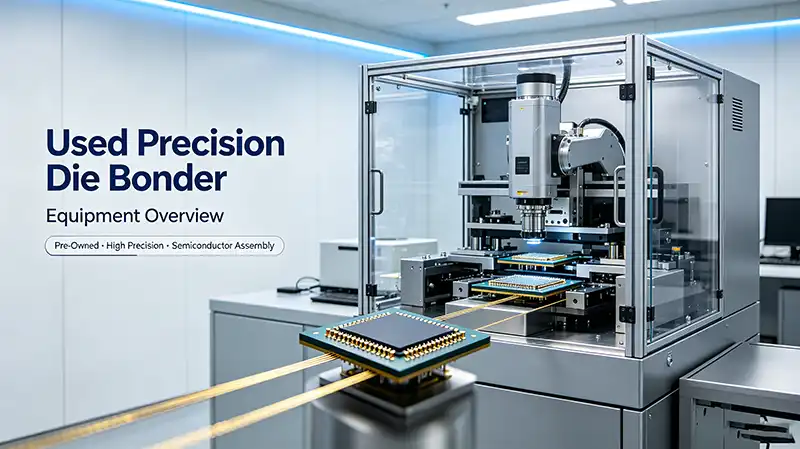
Buying a used die bonder is rarely about finding one for sale. The hard part is deciding whether a specific Used Die Bonder Machine is worth bringing into your fab. That decision involves four things: technical condition, process fit, long-term support, and total cost of ownership. What follows is organized around the questions that come up, in order, during an actual purchase — written for manufacturers currently evaluating used die bonding equipment.
Why You're Buying Used Determines How You Shop
Before contacting a single seller, get clear on why you're considering used in the first place. Different reasons lead to very different evaluation priorities.
If new equipment lead times are too long and you can't wait, used is a reasonable stopgap — focus on delivery speed and installation timeline. If your product is still ramping and the tool isn't a production bottleneck, downtime is manageable, so you can weigh cost-performance more heavily and tolerate a wider range of refurbishment levels. If your team can handle some maintenance in-house, as-is equipment becomes noticeably more attractive.
On the flip side: if this tool sits on a critical production step and a single day of downtime threatens delivery; or your accuracy requirements are already pressing against the ceiling of current technology; or your team has no maintenance experience and depends on the OEM for everything — then the money you save upfront on a used machine will likely come back doubled in downtime, rework, and maintenance.
Get this step wrong and every evaluation that follows loses its reference point.
Refurbished vs. As-Is: The Difference Isn't Just the Price
Once you've decided on used, the first real fork in the road is refurbished versus as-is. The price gap between them is often large, but what matters is what's hiding behind that gap.
Refurbished machines are rebuilt by the OEM or an authorized party. Worn parts are replaced, motion systems recalibrated, software restored to a licensable state, and a performance guarantee usually comes attached for a period of time. What you're buying is an asset with a known condition and someone to call when something goes wrong. For critical production steps, that certainty is the value.
As-is machines are cheaper, but cheap comes at a cost. Software licenses may not transfer with the hardware, requiring a separate purchase from the OEM. Critical spare parts may be long discontinued, with lead times that stretch for months. And when something breaks, the engineer who knew how to fix that model may have left the industry years ago. Add it all up, and the upfront savings can easily get eaten.
| Decision Factor | Factory-Refurbished | Third-Party As-Is |
|---|---|---|
| Equipment condition known? | Yes, with test reports | No, must verify yourself |
| Software license transferable? | Usually yes | Often requires separate purchase |
| Critical spare parts supply | OEM channel, controllable lead times | Depends on seller's stock, uncertain |
| Who supports when it breaks | OEM or authorized party | You're on your own |
| Accuracy guaranteed? | Yes, some with warranty | No, sold as-is |
| Hidden cost risk | Low | High, can offset the price gap |
| Best suited for | Production bottleneck, thin technical team | Non-critical steps, strong equipment engineering team |
The test comes down to two questions: Can you tolerate the downtime? Can you handle the repairs? If both answers are yes, as-is is worth discussing. If either is no, refurbished is the safer call.
Can This Machine Actually Do Your Job?
Only at this stage do you evaluate a specific machine. The core question isn't "Is this a good machine?" but "Is it right for my process?"
Start by laying out your own parameters: bonding process (thermocompression, eutectic, epoxy, or hybrid bonding), die size range, alignment accuracy requirements, and throughput targets. Use those to screen the equipment — don't let the machine's existing configuration dictate your thinking.
If you're looking at an Automatic Die Bonder, pay particular attention to whether its level of automation and changeover efficiency match your production plan. The value of an automatic die bonder lies in reducing manual intervention and improving consistency — but only if its feeding system, vision recognition, and recipe management can keep up with your product mix. A machine with high automation but slow changeover may not be more cost-effective than a manual or semi-automatic option in a high-mix, low-volume environment.
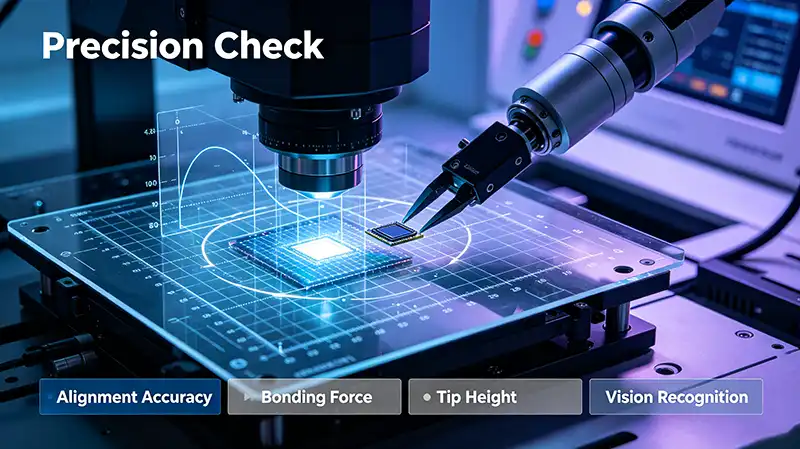
If accuracy is your core requirement, the evaluation centers on the alignment repeatability and motion platform stability of a High-Precision Die Bonder. The gap between a high-precision die bonder's specified accuracy and its actual accuracy tends to widen with age. What you need to see during inspection is repeatability data under continuous operation, not a single best-case number.
Run your inspection in this order of priority:
| Priority | Test Item | How to Test | What to Look For |
|---|---|---|---|
| 1 | Alignment accuracy & repeatability | Run standard calibration coupons through multiple cycles | Whether variation stays within your process window |
| 2 | Shear/pull force after bonding | Use real samples from your own line | Whether it meets your process requirements |
| 3 | Temperature profile stability | Measure under actual thermocompression or eutectic process | Overshoot and recovery time |
| 4 | Software functionality | Check recipe management and vision recognition item by item | Any locked modules requiring separate purchase |
| 5 | Safety system effectiveness | Test E-stop, light curtains, interlocks | All functions must work |
The most common mistake here is testing with demo samples the seller prepared. Demo samples are hand-picked to sit right in the machine's sweet spot — they won't reveal problems. Bond with real samples from your own production line to see how the machine performs under real conditions. Even if time is tight, the first three items are non-negotiable.
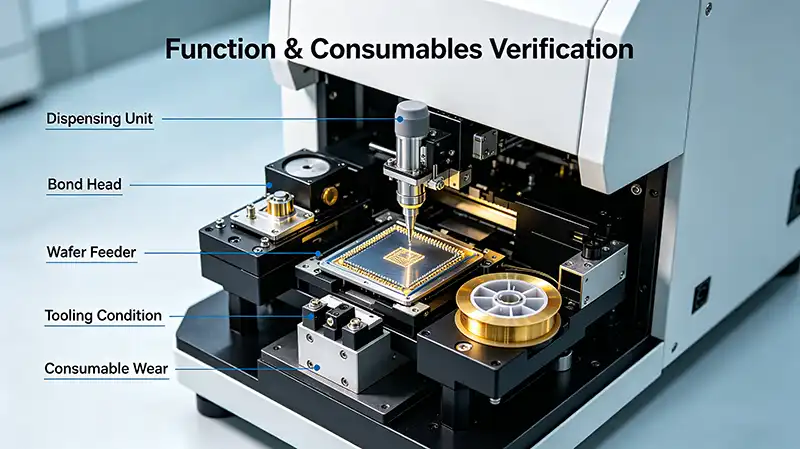
The internal subsystems — vision alignment module repeatability, bond head compatibility with your process, motion platform stability under continuous operation, software license completeness, spare parts availability, safety system integrity — are the technical foundation supporting those tests. Confirm each one during inspection.
Can You Afford to Keep It Running?
The purchase price is only part of total cost of ownership. This stage is about long-term affordability, and several cost items are especially easy to miss.
Software licensing ranks first. Many used machines have software licenses that don't transfer with the hardware, requiring a new purchase from the OEM — potentially 10%–20% of the machine's asking price. Ask about transfer conditions and costs early in the decision process, not after the machine arrives.
Spare parts and consumables availability determines maintenance costs. Whether consumables like bonding tools, nozzles, and heaters are standard types, and what lead times and prices look like from OEM or third-party channels. If critical spares exist only in the seller's inventory, you lose all pricing power down the road.
Installation, commissioning, and training — if the seller doesn't provide them, you'll arrange them yourself. Power, air, nitrogen, and cleanliness requirements need confirming in advance, and operator and maintenance training should be factored into the cost.
The inspection itself can't be skipped. On-site inspection costs manpower and time, and bonding tests with real samples involve sample costs and testing fees. That money is insurance, not waste.
How Long Will This Investment Last?
This stage examines whether the machine's lifespan matches your product roadmap — in other words, how many years this money will cover.
Advanced packaging is moving from wire bonding toward flip chip, thermocompression bonding, and hybrid bonding. Different routes place very different demands on equipment capability. If your roadmap includes new processes, finer bump pitches, or larger die within the next two to three years, confirm whether the machine you're looking at has upgrade headroom and accuracy margin.
A machine that just barely meets today's needs may not meet next year's. Conversely, if your application is stable, a well-maintained previous-generation High-Precision Die Bonder may match or exceed a new machine at the same price in accuracy and stability. Core mechanical precision and thermal control capability don't shrink dramatically with each generation — generational differences show up more in automation and software features.
If you're choosing an Automatic Die Bonder, there's an additional layer to consider: whether its automation architecture can adapt to future changes in die size and production ramp. Feeder compatibility, vision system expandability, and whether the software supports importing new recipes all affect the machine's actual service life.
The approach is straightforward: list your product roadmap for the next two to three years, then check it item by item against the machine's accuracy ceiling, process compatibility, and upgrade options. If anything doesn't line up, evaluate the upgrade cost or plan an alternative.
What to Lock Down in the Contract
The final stage is turning all the evaluation conclusions into enforceable contract protections.
Write acceptance criteria into the contract — accuracy specs, yield thresholds, and test methods all need to be explicit. Run acceptance tests with standard samples after the machine arrives, and only move to production once it passes.
Confirm software license status in the contract: whether the license transfers with the machine, whether high-precision modes require additional options, and who covers future upgrade costs.
Spell out spare parts supply and technical support arrangements: warranty period, response time, and spare parts lead time commitments. For what the seller doesn't provide, draw clear responsibility boundaries.
Agree on seller liability and dispute resolution mechanisms in advance, so you're not arguing after the machine arrives with no basis to stand on.
Frequently Asked Questions (FAQ)
Can a used die bonder still achieve the OEM's specified accuracy?
It depends on usage history and refurbishment quality. Machines with professionally calibrated motion systems and vision modules, and with critical worn parts replaced, typically recover 80%–95% of specified accuracy. As-is machines that have never been refurbished may fall significantly short. Ask the seller for recent measured data from standard calibration coupons — don't rely on the spec sheet alone. For High-Precision Die Bonders, repeatability data under continuous operation is more meaningful than a single accuracy figure.
What hidden costs are most often overlooked when buying a used die bonder?
Software licensing tops the list, potentially 10%–20% of the asking price. Second is spare parts supply — discontinued models can have lead times of several months. Third is installation, commissioning, and training, which you'll pay for yourself if the seller doesn't provide them. Automatic Die Bonders also carry additional automation software licensing and upgrade costs.
How do I know if a used die bonder is right for my application?
Start by clarifying your bonding process, die size range, alignment accuracy requirements, and throughput targets, then screen equipment specs against them. The single most important step is inspection testing with real samples. The machine is only a fit if it can meet your product roadmap needs for the next two to three years.
Refurbished or as-is — which is the better buy?
There's no universal answer — it depends on your risk tolerance and team capability. Refurbished costs more but comes with known condition, warranty, and technical support. As-is costs less, but you absorb the verification and repair risk. Once hidden costs are factored in, the total cost of ownership gap between the two may be much smaller than the price gap suggests.
How much longer can a used die bonder last?
Core mechanical components can last 15–20 years with proper maintenance. Subsystems like vision systems and bond heads may need more frequent maintenance or replacement. A machine that's been in service 5–8 years with a good maintenance record typically has another 7–10 years of reliable operation. Look at the maintenance history, not just the age.
What should I test first during inspection?
In priority order: alignment accuracy and repeatability, shear or pull force after bonding, temperature profile stability, software functionality, and safety system effectiveness. If time is limited, the first three are mandatory. For an Automatic Die Bonder, also test feeder system stability and changeover efficiency.
How do I ensure a smooth production ramp after purchase?
Confirm three things in advance: installation requirements, software license status, and operator and maintenance training arrangements. After the machine arrives, run acceptance tests with standard samples and confirm accuracy and yield meet agreed standards before moving to production. Write acceptance criteria and seller responsibilities into the purchase contract to avoid disputes later.
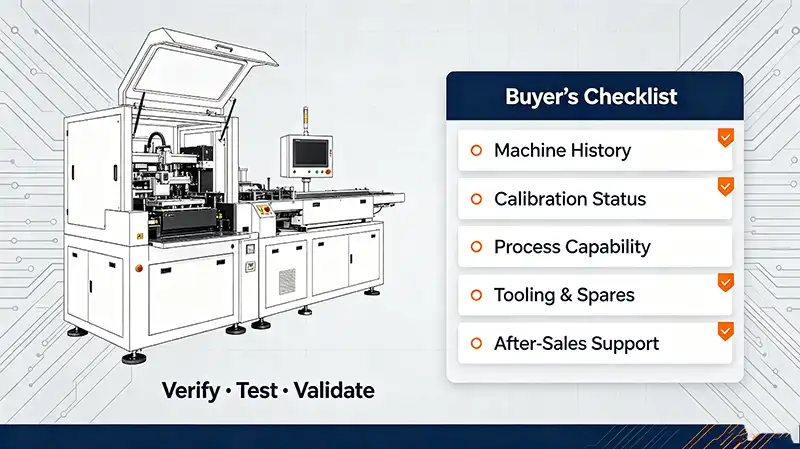
Buying a used die bonder is about technical judgment, not bargaining skill. Work through these six stages in order, and whether a Used Die Bonder Machine is worth buying will become clear.