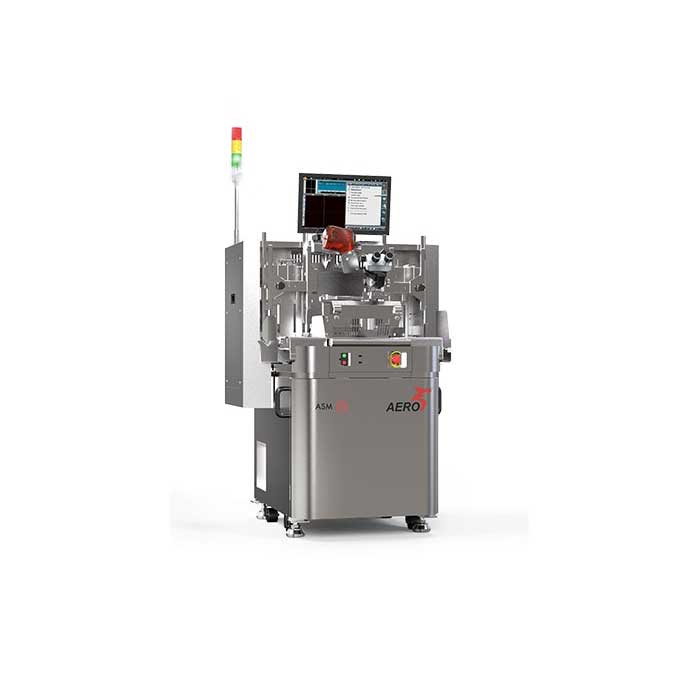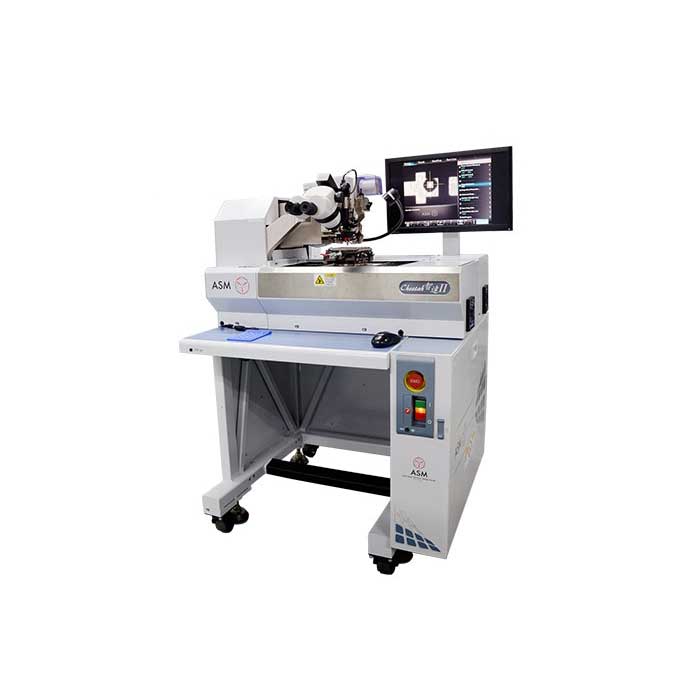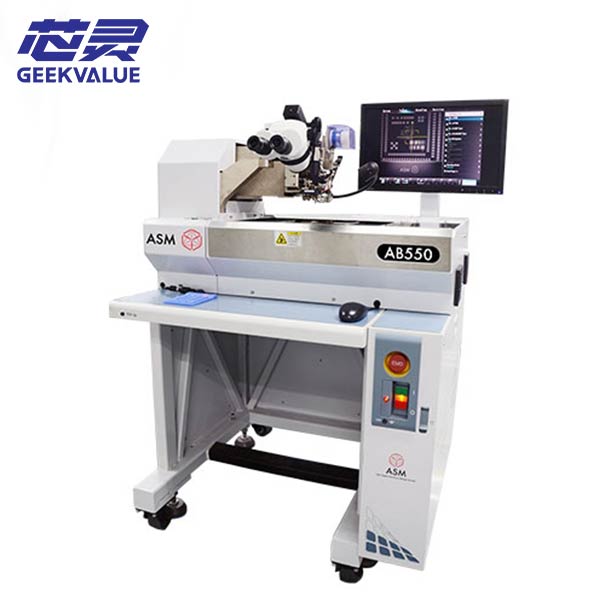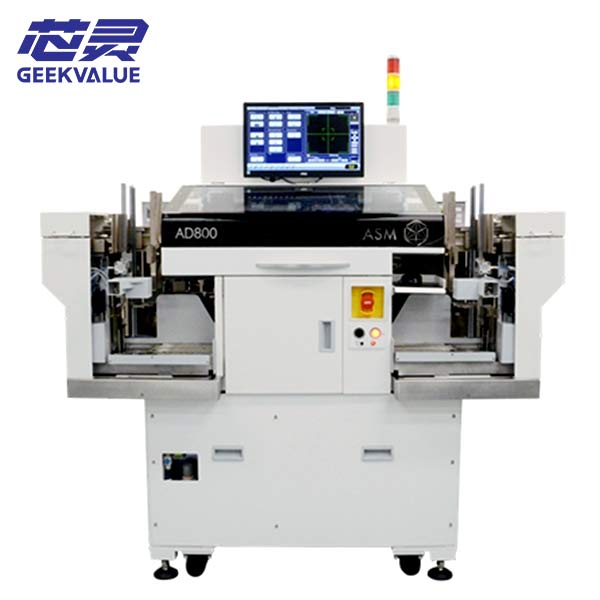
The ASM AD800 is a legacy high-speed automatic die bonder developed for volume die placement. Historical product data lists a 50 ms bonding cycle, ±25 μm XY placement accuracy, die handling down to 3 mil and material handling up to 270 × 100 mm.
Those figures describe the platform under specified conditions when it was originally supplied. They do not confirm that a particular used AD800 can still achieve the same output, accuracy or small-die performance.
For a used machine, the more important questions are which wafer system, material handler, bond head, vision functions and tooling are installed, and whether those components can be demonstrated with the intended product.
Published Specifications and Their Meaning on a Used Machine
| Item | Published Data | What Should Be Verified |
|---|---|---|
| Bonding Cycle | 50 ms | This is a nominal machine cycle, not guaranteed production UPH. Material indexing, inspection, skipping, loading and product layout all affect actual output. |
| XY Placement | ±25 μm @ 3σ | Check calibration, camera condition, stage repeatability and placement results using representative material. |
| Die Rotation | ±3° @ 3σ | Confirm that this tolerance is acceptable for the intended package and that theta recognition remains stable. |
| Minimum Die | Down to 3 mil | Requires suitable collets, ejector pins, wafer tape, lighting, pickup settings and undamaged small-die tooling. |
| Material Size | Up to 270 × 100 mm | The installed track, workholder, clamps and indexing setup must match the actual strip or substrate drawing. |
| Inspection | Pre-bond and post-bond inspection | Check cameras, lighting, pattern-recognition software, calibration and whether the required inspection functions are enabled. |
| Motion System | Linear motor | A linear motor reduces some mechanical transmission components, but encoders, guides, cables, bearings and servo electronics still require inspection. |
| Machine Dimensions | 1,570 × 1,160 × 2,057 mm | Confirm actual machine dimensions together with feeders, loaders, service clearance and shipping fixtures. |
Why a 50 ms Cycle Does Not Equal Finished Production Output
A 50 ms cycle mathematically represents 20 bonding cycles per second. It should not be interpreted as a guaranteed number of finished packages per hour.
Actual production output also includes:
Leadframe or substrate indexing
Wafer alignment and die search
Pre-bond inspection
Post-bond inspection
Bad-die and bad-unit skipping
Material loading and unloading
Package changeover and operator intervention
A useful throughput test must therefore use the intended die, wafer, receiving material and inspection recipe. A dry-cycle video only proves machine movement.
What Products Can an AD800 Run?
The AD800 is not tied to one finished product name. It transfers individual dies from a wafer to a compatible strip, substrate or other receiving material according to the installed process and tooling.
It may be suitable for an IC, discrete device, LED or another small-die product, but only when the following items match:
Die length, width and thickness
Wafer diameter, frame and tape
Die backside and top-surface condition
Required attach material and application method
Strip or substrate dimensions
Pickup and placement tolerance
Collet, ejector and workholder tooling
Required pre-bond and post-bond inspection
For this reason, an equipment listing should not claim compatibility with MOSFETs, memory devices, sensors or other products unless the available machine has the corresponding configuration or previous production record.
When a Used AD800 Still Makes Sense
A used AD800 is usually easier to justify in the following situations:
The factory already operates AD800 machines
Existing tooling and process files can be reused
Operators and maintenance staff already understand the platform
The required placement tolerance is compatible with the published specification
The available machine has the correct handler and workholder
Replacement electronics and mechanical parts can still be supported
It is a higher-risk choice for a completely new production line when no compatible tooling, software backup, maintenance experience or sample-production test is available.
AD800 and AD50Pro Should Not Be Compared by Headline Data Alone
The AD800 and ASM AD50Pro are both associated with published 50 ms cycle, ±25 μm placement and 3 mil die-handling figures.
That does not make two used machines interchangeable. Compare the actual material handler, inspection functions, wafer configuration, workholder, bond head, software and included tooling. A machine with the preferred model name but the wrong handler may cost more to convert than a correctly configured alternative.
Three Levels of Used-Machine Testing
1. Identity and Configuration Check
Verify the AD800 model on the nameplate
Record serial number and manufacturing year
Photograph installed modules and handlers
List included tooling and accessories
Record software version and available backups
2. Power-On and Functional Check
Start the control system without unresolved alarms
Home and move all relevant axes
Check bond-head motion and vacuum response
Check wafer table, ejector and material indexing
Test cameras, lighting and pattern recognition
Record abnormal noise, vibration and damaged components
3. Representative Production Test
Load the intended or comparable wafer material
Use matching strip, substrate or carrier material
Install the correct collet, ejector and workholder
Run pickup, placement and material indexing together
Measure placement and die rotation results
Record actual output and rejected units
The third level provides the strongest evidence, but it is only possible when suitable production materials and tooling are available.
Configuration Required for the Available AD800
| Machine Year | Confirm for the available unit |
|---|---|
| Serial Number | Confirm from the machine nameplate |
| Previous Application | Confirm from equipment history when available |
| Wafer System | Confirm wafer size, frame, loader and ejector configuration |
| Material Handler | Confirm input, indexing, workholder and output arrangement |
| Attach Process | Confirm installed dispensing, stamping or other process components |
| Inspection | Confirm pre-bond, post-bond and defect-skipping functions |
| Tooling | List included collets, ejector tools, workholders, clamps and magazines |
| Testing Status | State whether the machine is as-removed, powered on, function-tested or production-tested |
Availability, Price and Export
Availability should be confirmed against the physical machine rather than a generic model listing. Other used ASM and ASMPT die bonders may also be considered when the available AD800 does not match the required material handler or tooling.
Availability: Confirm before order
Condition: The quotation should state the completed inspection and test scope
Price: Based on machine year, configuration, condition, tooling and service scope
Export: International packing and shipment can be arranged subject to destination requirements
Send the die dimensions, wafer format, material drawing, attach process, placement requirement and destination through our equipment inquiry form to review an available machine.