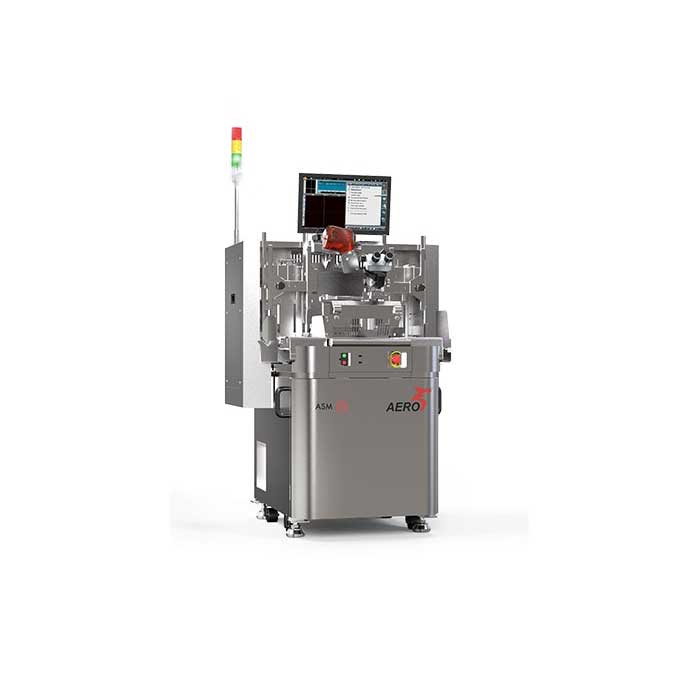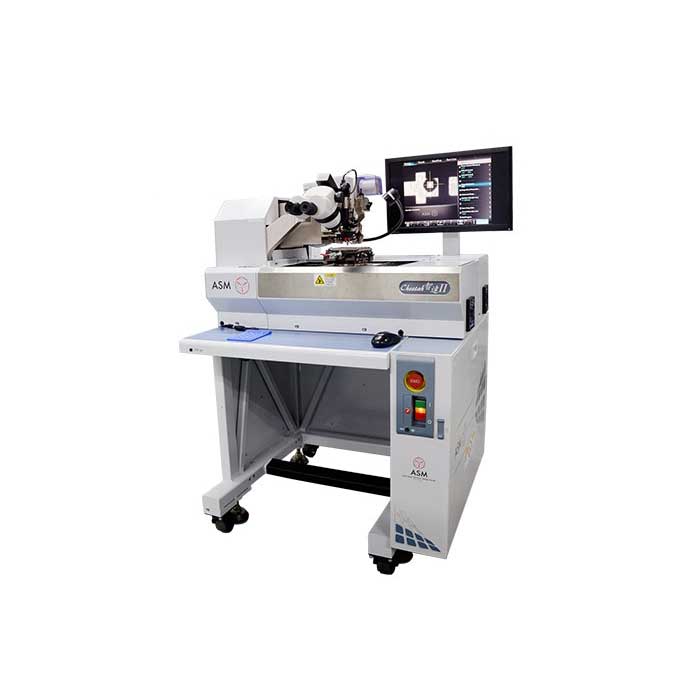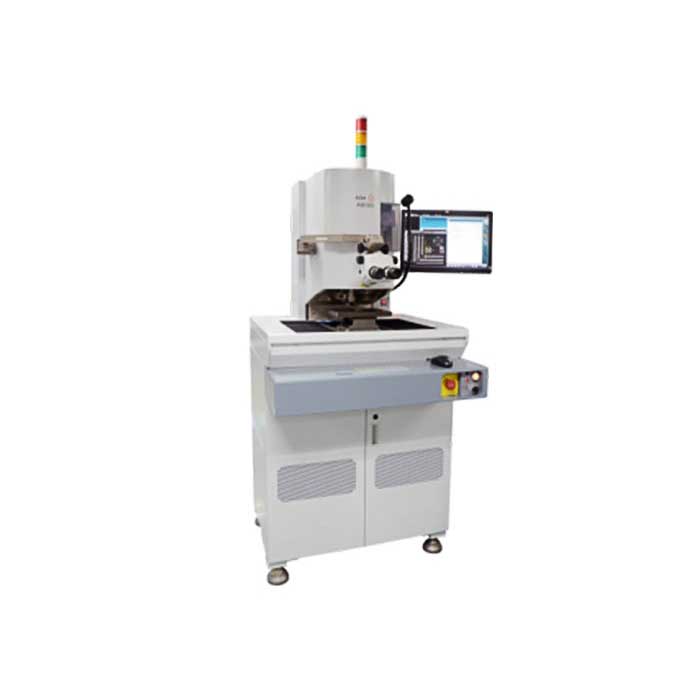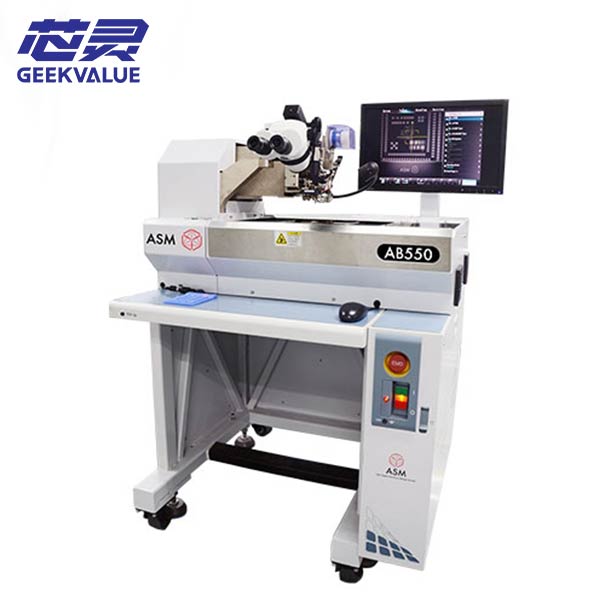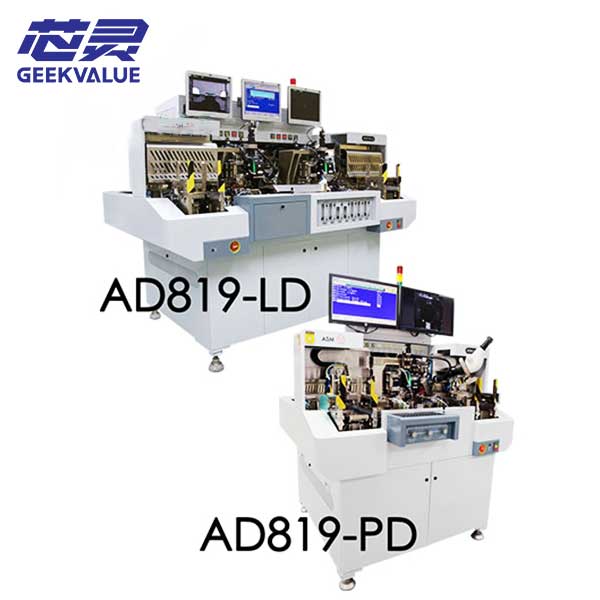
The ASM AD819 series consists of fully automatic die bonding systems developed for TO-can package assembly. Public historical information identifies two different process versions: the AD819-LD and the AD819-PD.
The suffix is essential when evaluating a used machine. The AD819-LD is configured for eutectic die bonding, while the AD819-PD combines dispensing and die bonding. A listing that identifies the machine only as “AD819” does not provide enough information for a purchasing decision.
The published series placement specification is ±15 μm @ 3σ. This is a reference value for the original platform, not evidence that an individual used machine currently meets the same result.
AD819-LD and AD819-PD Are Different Machines
| Version | Published Process | What the Used Machine Must Confirm |
|---|---|---|
| AD819-LD | Eutectic die bonding | Heating configuration, temperature control, bond tooling, material handling and any required process-atmosphere components |
| AD819-PD | Dispensing and die bonding | Dispensing hardware, material-delivery components, bond head, workholder, cameras and included process tooling |
The two versions should not be presented as software-selectable operating modes. Process capability is determined by the physical modules installed on the machine.
Published AD819 Series Information
| Manufacturer | ASM / ASM Pacific Technology |
|---|---|
| Series | AD819 |
| Known Versions | AD819-LD and AD819-PD |
| Equipment Type | Fully automatic die bonding system |
| Package Format | TO-can package processing |
| Published Placement Accuracy | ±15 μm @ 3σ |
| AD819-LD Process | Eutectic die bonding |
| AD819-PD Process | Dispensing and die bonding |
Publicly available information does not provide enough evidence to state a universal wafer size, die-size range, throughput, bonding temperature or material-handling format for every AD819 machine. These items must be taken from the exact machine documentation or verified physically.
What the ±15 μm Specification Means
The published ±15 μm @ 3σ value places the AD819 above basic uncontrolled placement equipment, but it does not make the machine a modern ultra-high-precision bonder.
On a used AD819, placement performance depends on:
Condition and calibration of the vision cameras
Lighting stability and pattern-recognition quality
Bond-head and stage mechanical condition
Encoder, motor and motion-controller response
Die dimensions and surface contrast
TO-can fixture and workholder repeatability
Temperature-related movement on an AD819-LD
Dispensing consistency on an AD819-PD
A machine that starts normally may still fail placement repeatability. Accuracy should be checked with representative dies and TO-can components whenever possible.
If the assembly genuinely requires approximately ±3 μm placement rather than ±15 μm, the ASMPT AD280 Plus high-precision die bonder is a more relevant platform to evaluate.
What Products Can the AD819 Series Make?
The confirmed application is TO-can package assembly. TO-can is a package format rather than one specific finished product, so the equipment should not automatically be assigned to every laser, photodiode, sensor or RF device.
Product compatibility depends on:
TO-can body dimensions and fixture design
Die length, width and thickness
Die input format and wafer configuration
Required placement tolerance
Eutectic material and temperature profile for AD819-LD
Adhesive and dispensing requirement for AD819-PD
Bond force, height and tool design
Required inspection and traceability
The previous production application is useful evidence, but it does not replace a comparison with the new product drawing and process requirement.
Evaluating a Used AD819-LD
An AD819-LD should be assessed as a eutectic-process machine, not only as a precision placement system. The inspection should cover:
Complete model designation showing AD819-LD
Heating stage and temperature-control hardware
Temperature sensor condition and calibration status
Bond head and installed eutectic tooling
TO-can fixtures, clamps and workholders
Die pickup, ejector and vacuum response
Any installed gas or atmosphere-control components
Camera operation before and during the heated process
Available process recipes and software backup
A room-temperature placement test does not prove eutectic bonding capability. The thermal system and placement result under the intended process conditions must be evaluated separately.
Evaluating a Used AD819-PD
An AD819-PD should be checked around both the dispensing process and die placement. Important items include:
Complete model designation showing AD819-PD
Installed dispensing unit and controller
Material reservoir, tubing, valves and dispensing tools
Dispense-position recognition and calibration
Dot size and repeatability with representative material
Bond head, collet, ejector and vacuum system
TO-can input, positioning and output handling
Pre-bond and post-bond camera functions
Software version and available product recipes
A video showing the bond head moving does not demonstrate dispensing performance. Material flow, dot consistency and the relationship between dispense position and die placement should be tested together.
Why Converting Between LD and PD May Not Be Practical
An inexpensive AD819-PD should not be purchased on the assumption that it can easily be converted into an AD819-LD, or vice versa.
A conversion may involve process modules, heating or dispensing hardware, controllers, wiring, software, workholders, bond tools and calibration. Missing original parts and unsupported software can make the conversion more expensive than sourcing the correct version.
For a used-equipment project, selecting the correct suffix at the beginning is normally safer than planning a major process conversion after purchase.
Information Required for the Available Machine
| Exact Model | AD819-LD or AD819-PD |
|---|---|
| Serial Number and Year | Confirm from the machine nameplate |
| Previous Product | Record previous TO-can format and process when available |
| Process Modules | List installed eutectic or dispensing components |
| Die Input | Confirm wafer, frame, loader and ejector configuration |
| TO-can Handling | Confirm input, fixtures, workholders and output method |
| Included Tooling | List collets, ejector tools, fixtures, clamps and process tools |
| Software | Record software version, licenses and available backups |
| Test Status | State whether the machine is as-removed, powered on, function-tested or process-tested |
Used AD819 Availability
Availability must be stated separately for the AD819-LD and AD819-PD. A generic “AD819 in stock” description is not sufficient because the two versions address different die attach processes.
Other used ASM and ASMPT die bonders may be considered when the available AD819 version does not match the required process.
Exact version: Confirm AD819-LD or AD819-PD
Condition: State the completed inspection and test scope
Price: Quote according to version, modules, tooling and condition
Export: International packing and shipment can be arranged subject to destination requirements
Send the required AD819 suffix, TO-can drawing, die information, bonding process and destination through our equipment inquiry form.