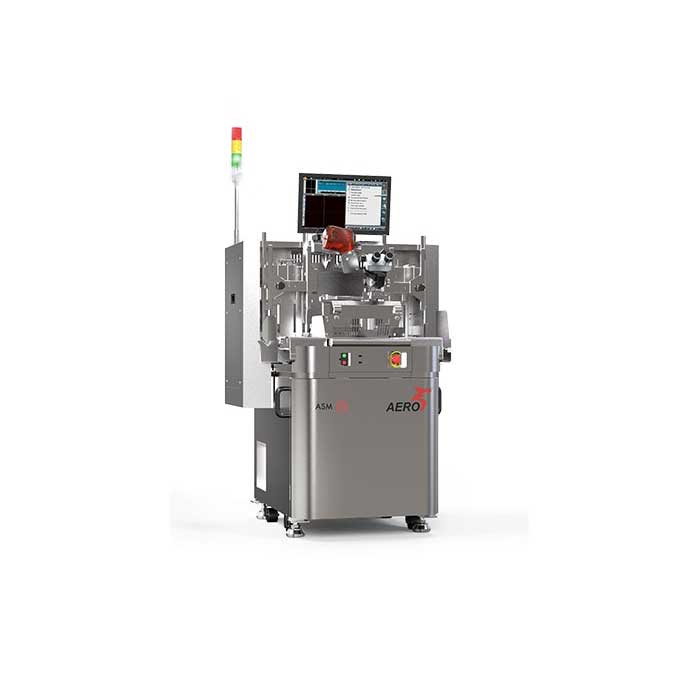
The ASMPT AD832i is an 8-inch automatic epoxy die bonder developed for small semiconductor packages. ASMPT identifies QFN, SOIC and SOP among its supported package families and lists die handling down to 6 mil under specified conditions.
For a used AD832i, the most important question is not whether the bond head can move. The machine must demonstrate two separate capabilities: consistent pickup and placement of the intended die, and stable dispensing of the required epoxy volume.
A machine may handle a small die mechanically but still produce unstable dots, epoxy tails, overflow or inconsistent bond-line thickness. These results depend on the dispensing hardware, epoxy material, tooling, calibration and product recipe.
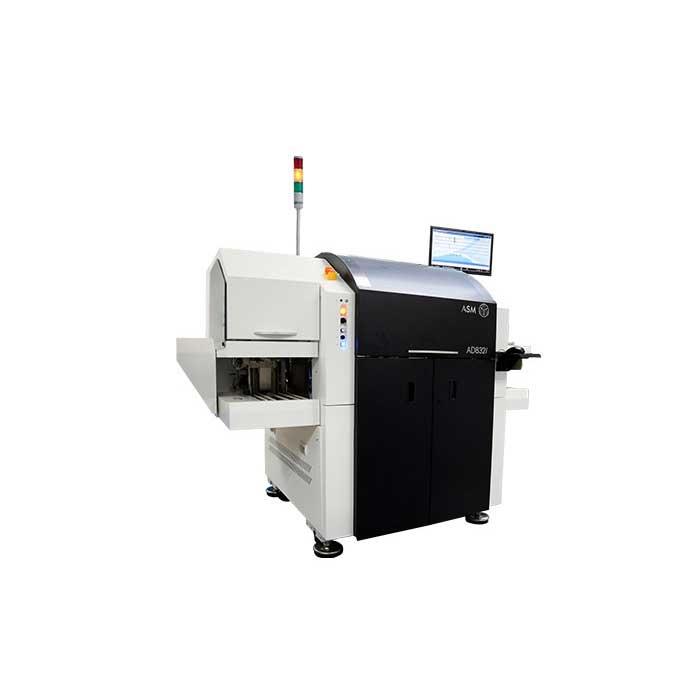
Independent Assessment of a Used AD832i
| A Practical Choice When | A Higher-Risk Choice When |
|---|---|
| The production line uses wafers up to 8 inches. | The intended production input requires a 12-inch wafer platform. |
| The product uses a small leadframe-based package such as QFN, SOIC or SOP. | The receiving material is a large substrate, module carrier or unsupported format. |
| The required process is epoxy die attach. | The product requires soft solder, eutectic, silver sintering or flip chip bonding. |
| Matching workholders, collets, ejector tools and dispensing parts are available. | The machine is missing product tooling or dispensing hardware. |
| The factory already operates AD832i or another compatible ASMPT platform. | No software backup, recipe, maintenance experience or sample test is available. |
A used AD832i is often easier to justify as an addition or replacement in an existing 8-inch small-package line. For a completely new line, conversion cost and continued support for tooling, software and dispensing components should be considered before comparing the purchase price.
Published AD832i Features and Their Used-Machine Meaning
| Published Feature | What It Means | What Must Be Proven |
|---|---|---|
| 8-inch wafer handling | The platform is designed around wafers up to 200 mm. | Confirm the installed loader, wafer table, frame, expander and ejector configuration. |
| 6 mil die handling | The platform was developed to handle very small dies under specified conditions. | Verify the collet, ejector needle, ejector cap, wafer tape, lighting and pickup parameters. |
| Ultra-small-dot dispensing | The dispensing system can be configured for small epoxy deposits. | Test the required material for dot volume, shape, position, tailing and repeatability. |
| Dual dispensing system | The platform includes two dispensing channels or stations. | Confirm that both dispensing paths, controllers, pumps and calibration functions are complete. |
| High-density leadframe handling | The machine supports volume processing of compatible leadframe layouts. | Compare the actual strip dimensions, matrix, indexing pitch, magazines and workholder. |
| Patented bond-head design | The bond arm is a defining part of the original platform. | Inspect movement, bearings, motors, encoders, vacuum response and placement repeatability. |
| Graphical SPC and IQC | The platform provides production and quality-monitoring functions. | Check the software version, enabled functions, licenses, data storage and communication interfaces. |
ASMPT does not publish one universal throughput, placement accuracy or epoxy-dot size for every AD832i product. These values should not be estimated from the model name.
Why 6 Mil Capability Requires More Than a Small Collet
The published 6 mil capability is approximately 0.152 mm, but it does not mean every AD832i can immediately run every die of that size.
Reliable small-die handling depends on the complete pickup system:
Die length, width, thickness and surface condition
Wafer tape type and expansion condition
Ejector needle size, position and upward motion
Ejector cap and wafer support
Collet opening, material and allowable pickup area
Pickup height, vacuum level and release timing
Camera resolution, lighting and die contrast
Die rotation and placement tolerance
A dry-cycle test without a wafer proves only that the axes and bond arm can move. Small-die capability requires pickup and placement using representative wafer material and matching tooling.
Dispensing Condition Is a Major Buying Risk
On an older epoxy die bonder, dispensing condition can be more important than the machine’s headline speed. Dried material, worn valves, damaged pumps, blocked lines or incomplete calibration hardware can prevent stable production even when the rest of the machine operates normally.
The dispensing system should be checked for:
Number and type of installed dispensing units
Pump, valve and controller condition
Needle holders, needles and height-calibration functions
Material reservoirs, pressure lines and connectors
Residual cured epoxy or contamination
Dispense position relative to the leadframe pad
Dot volume and shape across a production strip
Tailing, dripping, splash and missing-dot detection
The machine should be tested using the intended epoxy or a technically comparable material. A water or dry dispensing demonstration does not prove production performance because viscosity, filler content, working life and temperature behavior affect the result.
Package Compatibility Must Be Checked by Drawing
QFN, SOIC and SOP are package families rather than single fixed dimensions. The package name alone is not enough to confirm machine compatibility.
| Die | Length, width, thickness, pickup surface and allowable placement tolerance |
|---|---|
| Wafer | Diameter, frame format, tape and wafer-map requirement |
| Leadframe | Strip length, width, thickness, matrix layout, pitch and surface condition |
| Epoxy | Material type, viscosity, filler content, required dot volume and working life |
| Tooling | Workholder, clamps, magazines, collet, ejector and dispensing needle |
| Acceptance | Die position, rotation, epoxy coverage, bond-line thickness and overflow limits |
The current page should not describe the process specifically as “silver epoxy” unless the available machine’s previous application or the customer’s intended material confirms it. ASMPT’s published description identifies the AD832i as an epoxy die bonder, which is the safer and more accurate wording.
Three Levels of Used AD832i Testing
1. Identity and Configuration
Verify the model, serial number and manufacturing year
Record the wafer and leadframe handlers
List the dispensing units and controllers
List all workholders, collets, ejector tools and change parts
Record the software version, licenses and available backups
2. Functional Testing
Start the machine and record unresolved alarms
Test wafer loading, wafer-table movement and ejector operation
Test leadframe loading, indexing and unloading
Check the bond head, vacuum system, cameras and lighting
Operate both dispensing paths when installed
Check IQC, SPC and inspection functions
3. Representative Product Test
Use the intended or comparable wafer and leadframe
Install matching pickup, dispensing and workholder tooling
Run representative epoxy material
Measure dot consistency, placement and die rotation
Check epoxy coverage, overflow and bond-line condition
Record actual production output and rejected units
The third level provides the strongest evidence. A powered-on machine should not be described as production-tested unless dispensing, pickup, placement and material handling have been operated together.
AD832i or a 12-Inch Die Bonder?
The AD832i remains relevant when the factory uses 8-inch wafers and small leadframe packages. Moving to a 12-inch platform does not automatically improve the project if the existing wafers, tooling, recipes and production line are already based on the AD832i.
If the project requires 12-inch wafer input or larger high-density leadframes, compare the ASMPT AD8312Plus 12-inch epoxy die bonder. The decision should be based on actual material format and conversion cost rather than model age alone.
Used ASMPT AD832i Availability
Availability and price depend on the year, dispensing configuration, wafer and leadframe handlers, software, included tooling and completed test scope of the actual machine.
Other used ASM and ASMPT die bonders may be considered when an available AD832i does not match the required wafer, leadframe or epoxy process.
Availability: Confirm against the physical machine
Configuration: Supplied with an itemized module and tooling list
Condition: Defined by the completed inspection and testing scope
Price: Quoted according to the actual machine and included components
Export: International packing and shipment can be arranged
Send the package drawing, die dimensions, wafer format, leadframe dimensions, epoxy information, placement requirement and destination through our equipment inquiry form.