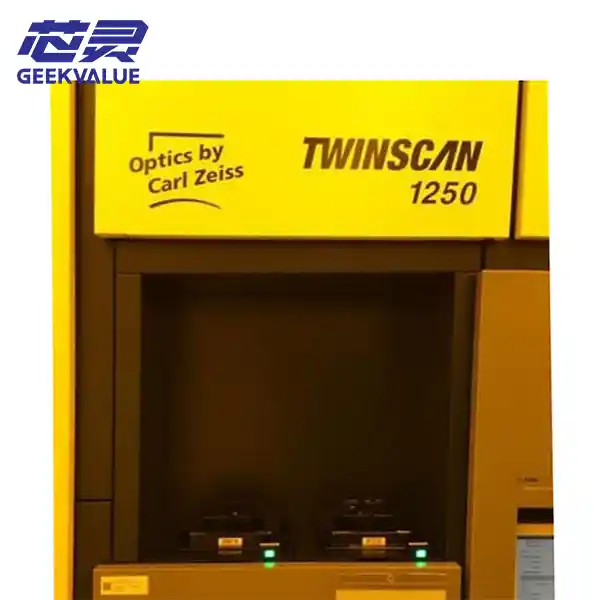
The ASML TWINSCAN XT:1250i brought 193 nm ArF immersion lithography into early process development for sub-65 nm patterning. By introducing water between the projection lens and wafer, the system increased the effective numerical aperture beyond the limits of dry ArF exposure, enabling finer pattern imaging.
Its dual-stage architecture separates wafer exposure from alignment and metrology tasks, allowing measurements on one stage to proceed while the other handles exposure. This parallel workflow helps maintain scanner productivity while controlling focus and overlay during repeated wafer processing.
The XT:1250i played a role in early immersion lithography evaluation for logic and memory applications. Its actual imaging capability depends on the optical configuration, illumination settings, resist stack and process conditions.