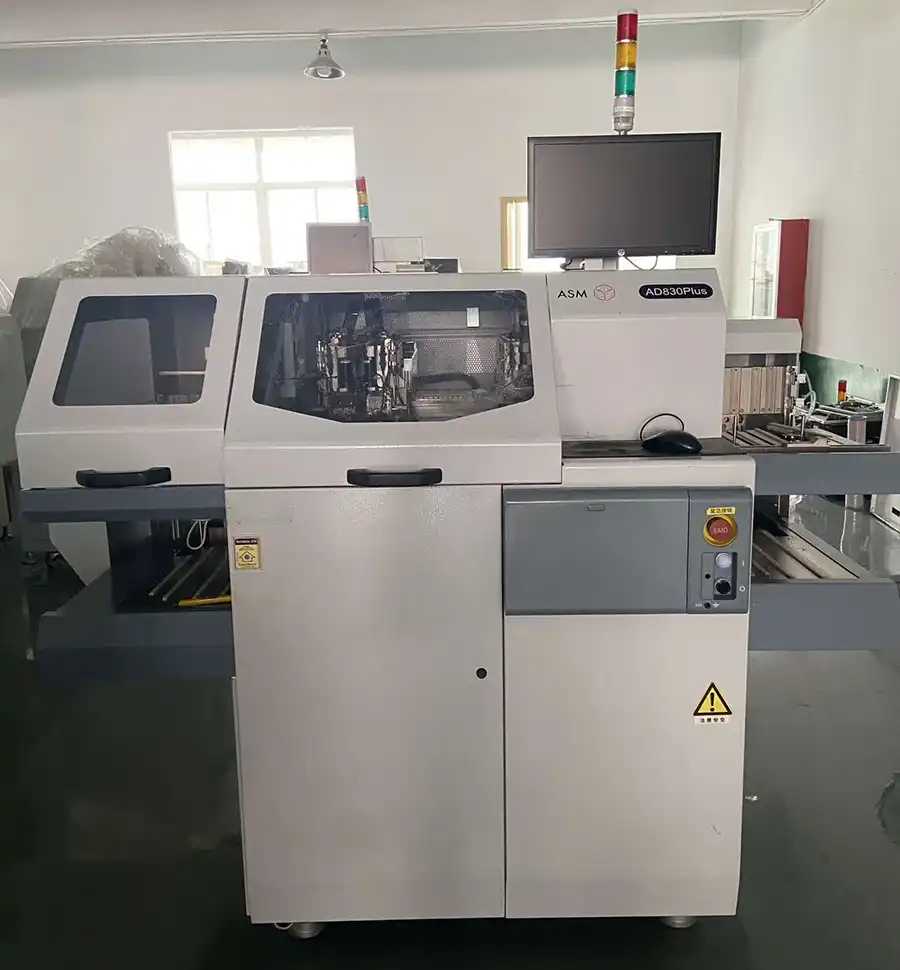
The ASMPT AD830 Plus is a high-speed automatic die bonder developed around a coordinated placement process: adhesive stamping or dispensing, die pickup, automatic theta correction, placement and optical inspection.
ASMPT publishes a maximum bonding rate of 22,000 UPH. That figure is useful for comparing platforms, but it should not be treated as the expected output of every used AD830 Plus.
On an operating line, output depends on the installed material handler, adhesive process, die-search time, inspection settings, product layout and frequency of operator intervention. The machine should therefore be evaluated as a complete process rather than a fast-moving bond head.
Our Assessment of the AD830 Plus
The AD830 Plus makes the most sense when production requires fast repetitive die placement together with adhesive application and optical inspection. Its rotary collet arm, linear-motor bond head and fixed optical arrangement were designed to reduce time inside the bonding cycle.
The machine is less attractive when the required material format does not match the installed handler or when the original stamping, dispensing and workholder tooling is missing. Rebuilding those parts for a new package can remove much of the cost advantage of buying used equipment.
For this model, the most valuable used-machine evidence is not an idle-speed video. It is a continuous run showing adhesive application, die pickup, theta correction, placement, inspection and material indexing working together.
Published Features and Their Value on a Used Machine
| Published Feature | What It Means | What Needs to Be Demonstrated |
|---|---|---|
| Up to 22,000 UPH | A maximum platform rate under suitable package and material conditions | Continuous output using comparable dies, receiving material, adhesive and inspection settings |
| Double decoupled linear-motor bond head | Designed to support fast bond-head movement | Stable homing, repeatable pickup height, smooth motion and no recurring servo alarms |
| Dual stamping or dot dispensing | Adhesive application is part of the machine’s throughput strategy | Correct installed modules, tooling, material compatibility and repeatable deposit results |
| Rotary collet bond arm | Allows automatic die-angle correction during pick and place | Theta recognition, rotation movement, collet condition and final die-angle results |
| New stamping-arm design | Intended to shorten package conversion | Availability of matching stamping tools, setup parts and process parameters |
| Magnetic anvil block | Supports faster workholder or package changeover | Correct anvil blocks, clamping condition, flatness and repeatable installation |
| Static bond optics | Removes optical-axis movement from part of the inspection cycle | Camera condition, lighting, calibration and reliable recognition of the intended materials |
| Simultaneous pre-bond and post-bond inspection | Inspection is used without adding separate sequential movements | Both inspection functions must operate correctly with the required recipe and product contrast |
ASMPT states that performance is package- and material-dependent. A used machine should not be sold on the 22,000 UPH figure unless the test conditions are also stated.
Why 22,000 UPH Is Not the Finished-Line Output
The published rate represents the machine operating under a suitable process condition. It does not automatically include every delay that appears during production.
Actual output can be reduced by:
Wafer alignment and die-search time
Bad-die or bad-unit skipping
Adhesive replenishment and cleaning
Stamping or dispensing inspection
Receiving-material indexing
Pre-bond and post-bond recognition settings
Die pickup retries
Material loading and unloading
Operator alarm recovery
A bond-head dry cycle may look fast while the complete process runs much more slowly. The useful figure is sustained output over a representative production period, together with rejected placements and stoppage records.
The Adhesive Process Can Become the Bottleneck
The AD830 Plus uses stamping or dot dispensing as part of the die-attach sequence. These are not interchangeable descriptions. The available machine must be identified by the hardware actually installed.
For a Stamping Configuration
Inspect the stamping arm and drive mechanism
List the included stamp tools and adhesive trays
Check pickup depth and adhesive-transfer consistency
Inspect the magnetic anvil blocks and locating surfaces
Confirm that the stamp pattern suits the intended die size
For a Dot-Dispensing Configuration
Identify the dispenser, controller and valve type
Inspect reservoirs, tubing and material-contact parts
Check dot position, diameter and volume repeatability
Confirm compatibility with the intended adhesive viscosity
Run dispensing and placement together rather than testing them separately
A machine can complete die placement correctly and still fail the process because the adhesive deposit is inconsistent. Deposit quality should be included in the acceptance criteria.
Fast Changeover Depends on the Parts That Come with the Machine
The redesigned stamping arm and magnetic anvil system were intended to reduce package-conversion time. On a used machine, that advantage depends heavily on what remains with the equipment.
The changeover claim has limited value when the machine is missing:
Product-specific anvil blocks
Workholders and clamps
Stamping or dispensing tools
Collets and ejector tooling
Wafer-frame components
Material magazines
Calibration fixtures
Original product recipes
If frequent package conversion is part of the purchasing reason, the inspection should include one complete tooling change followed by material setup, vision teaching and a short production run. Quoting only the mechanical change time gives an incomplete result.
What the Vision System Must Prove
The AD830 Plus uses a static bond-optics arrangement and can perform pre-bond and post-bond inspection together. This reduces movement inside the machine cycle, but it does not guarantee reliable recognition of every die or receiving material.
Vision performance should be checked with the actual surface conditions expected in production:
Die metallization and surface reflectivity
Wafer-map and bad-die information
Bond-site contrast
Adhesive near the placement area
Pre-molded or reflective receiving materials
Required missing-die and misplaced-die detection
Die-angle measurement after placement
A camera image appearing on the monitor proves only that the camera is operating. Recognition stability, calibration and inspection decisions must be tested through repeated cycles.
Which ASMPT Die Bonder Is the Better Match?
| Model | Primary Buying Reason | Where It Differs from AD830 Plus |
|---|---|---|
| AD830 Plus | High-speed adhesive die bonding with fast stamping or dispensing and integrated inspection | The main evaluation point is whether the complete process can approach the published 22,000 UPH |
| AD832i | Small-package epoxy die attach with published 6 mil die and ultra-small dot capability | More relevant when the challenge is very small dies or adhesive deposits rather than maximum headline speed |
| AD8312Plus | 12-inch wafer input and high-density leadframe epoxy production | More relevant when wafer and receiving-material capacity drive the equipment choice |
| AD838L-Plus | Large, fragile or scratch-sensitive substrate transport | Selected for its dragging-free material handling rather than the AD830 Plus speed architecture |
| AD280 Plus | Published ±3 μm placement and flip-chip handling | More suitable when placement precision and die orientation matter more than high-speed conventional die attach |
The fastest machine on paper is not necessarily the fastest machine for the intended product. Tooling availability, material format and inspection time often decide the final result.
How We Would Test a Used AD830 Plus
1. Confirm the Machine Identity
Record the complete model designation and serial number
Confirm manufacturing year and previous application when available
List the wafer, material-handling and adhesive modules
Record the software version and enabled inspection functions
2. Inspect the High-Speed Mechanisms
Home and exercise the linear-motor bond head
Check the rotary collet arm and theta movement
Inspect cables, guides, encoders and vacuum response
Record servo alarms, vibration and abnormal noise
3. Test Adhesive Application
Run the installed stamping or dispensing system
Measure deposit position and consistency
Check cleaning requirements and material buildup
Confirm that adhesive application keeps pace with placement
4. Run the Complete Bonding Sequence
Load representative wafer and receiving material
Run die recognition, pickup and theta correction
Run pre-bond and post-bond inspection
Record sustained output rather than a short peak rate
Record pickup failures, inspection rejects and machine stops
The final report should separate mechanical operation, adhesive performance, placement results and sustained output. Combining everything into “machine tested” tells the buyer very little.
Information Required for the Available AD830 Plus
| Machine Identity | Model, serial number, year and current nameplate photographs |
|---|---|
| Previous Application | Previous die, package and adhesive process when records are available |
| Wafer Configuration | Wafer size, frame type, wafer table, expander and ejector system |
| Receiving Material | Installed transport, workholder, clamps, magazines and indexing direction |
| Adhesive Process | Stamping or dot dispensing, including controller and material-contact components |
| Bond Tooling | Collets, ejector tools, stamp tools, anvil blocks and calibration fixtures |
| Vision Functions | Installed cameras, lighting, pre-bond inspection and post-bond inspection |
| Software | Software version, licenses, backups and available product recipes |
| Production Evidence | Test material, run duration, achieved output, rejects and unresolved alarms |
Used AD830 Plus Availability
An AD830 Plus should be priced according to its complete process configuration, not only its model and year. A machine supplied with matching anvil blocks, adhesive tools, workholders and recipes may be more useful than a lower-priced unit missing its production tooling.
Send the die dimensions, wafer format, receiving-material drawing, adhesive method, required inspection and target output through our equipment inquiry form. We can then compare the required process with the physical machine and its included tooling.