Semiconductor Equipment Service
Temperature Controller Repair
Semiconductor temperature controller and control-board repair. Restore failed sensor inputs, output drives, power circuits and communication paths on the original module. GK-SEMI supports component-level repair and matched sourcing, keeping installed configuration requirements in view.
What we repair
Controller Faults & Repair Routes
Start with the failed input, output, power or communication path, then determine whether board repair or a compatible replacement is the better route.
Original-Board Component Repair
Restore failed thermocouple/RTD inputs, zone outputs, power sections and interface circuitry without replacing an otherwise serviceable controller.
- Thermocouple / RTD input amplifier and A/D path
- SSR, relay and output driver stage
- Power board: capacitor, regulator, battery
- RS485 / Modbus and backplane interface
- Configuration recovery and CMOS battery
Matched replacement
When repair is not viable, a compatible module is matched in the same window.
- Discontinued or unavailable module
- Sealed calibration that cannot be reopened
- Match by part number, revision, backplane
- Substitute status stated before commitment
- Not presented as an OEM replacement
Clear boundary
Some modules should not be repaired. The boundary is stated before work starts.
- Severe substrate burn or delamination
- Safety-interlock faults that cannot be verified
- Module that still fails agreed checks
- No repair outcome promised before assessment
- Sourcing discussed as the next step
Why GK-SEMI
Choose the Right Service Route
Factory service, independent repair and GK-SEMI each have different scope, availability and test boundaries. Compare them against the actual module rather than broad claims about every provider.
Factory route
Subject to OEM policy. Support for older modules depends on the original manufacturer and product status.
Decided by support policy. Sourcing and exchange options depend on manufacturer policy and availability.
Governed by OEM repair queue and part availability. Can be long for legacy modules.
OEM-defined test protocol; documentation depends on the factory route and customer agreement.
Third-party route
Component-level capability varies. Some channels replace boards rather than repair the original.
Repair depth and sourcing support vary by independent service provider.
Varies by shop and by whether parts are on hand. Quoting and inspection practices differ by provider.
Ask which functional checks are included and which require confirmation on the installed machine.
Repair + sourcing window
Component-level repair on the installed board. The original board retains its identity; settings are checked and backed up where practical.
Repair if viable. If not, sourcing matched by part number, revision and backplane, with substitute status stated.
Quoted against the actual module and repair scope. Scope changes are reported.
Bench checks are defined separately from any customer-side on-tool confirmation.
Our strengths
What Our Team Brings
Beyond fault isolation, repair decisions need to account for the controller’s channel layout, software settings, tool interface and replacement availability.
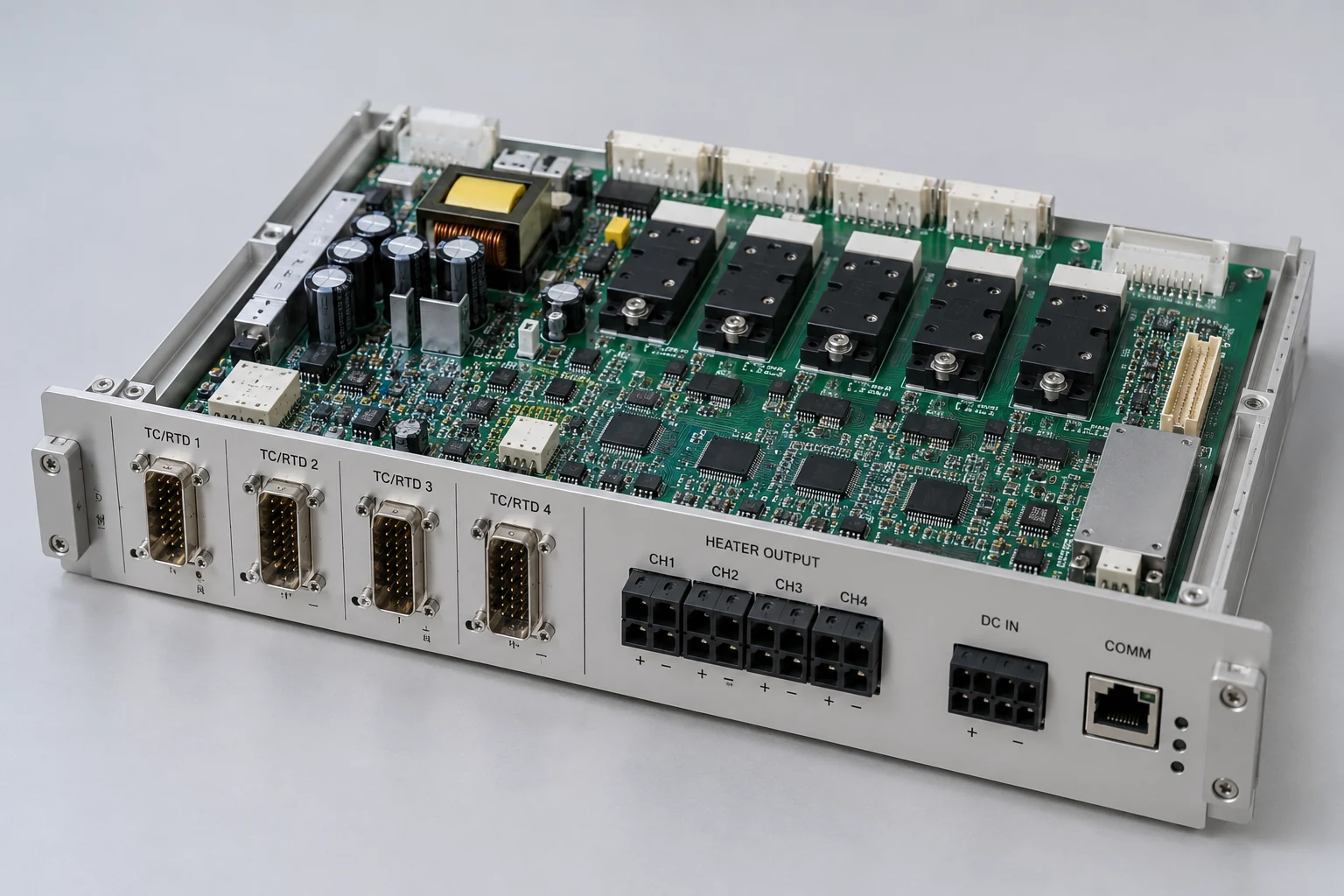
Input & Output Experience
Thermocouple/RTD input paths, relays, SSR drivers and power stages are investigated at component level. A single failed zone does not always require replacement of every channel.
Configuration Awareness
Original-board repair reduces replacement and configuration changes; stored settings are checked and backed up where practical.
Legacy Module Support
Legacy controller support extends to matched parts sourcing when original-board repair is not practical.
Verification Boundaries
The assessment defines what can be checked on a bench and what needs final verification on the tool after refit, particularly closed-loop thermal behavior.
Repair record
Recovering a Failed Temperature Zone
A drifting zone on a multi-zone thermal chuck controller led to a targeted input-channel repair.
From a drifting zone to a decided route
Reported symptom: One zone drifting and occasionally reading out of range during soak. Other zones held their setpoints, no wiring change had been made.
Isolation before quoting: Sensor and wiring checked at the terminals first. Other zones used as an on-board reference since they share the same backplane and power.
Confirmed fault: The controller’s reading for that zone disagreed with the terminal measurement while other channels read correctly. Fault localised to that channel’s input path — A/D sampling or input amplifier, not the whole card.
Repair action: Input channel repaired at component level on the original board. The other channels remained in place, with settings preserved where verified.
Verification boundary: Bench checks covered the repaired channel. The case record reports closed-loop checks on the customer tool after refit. A bench pass is not presented as thermal validation of the whole chuck.
If repair had not been possible: Sourcing would have been opened in the same window, matched by part number, revision and backplane, with substitute status stated up front.
Before You Ship
Temperature Controller FAQs
Clear answers on configuration retention, channel repair, and sourcing fallback.
Will I lose my PID parameters or configuration?
Repairing the original board can help preserve settings, but battery or memory faults may require backup, re-entry or revalidation. Share the parameter file if available.
Can a single failed controller zone be repaired?
Yes, a single thermocouple/RTD input, relay output or driver channel can be assessed at component level. Other shared circuits are checked before deciding the repair extent.
Which faults can you inspect?
Sensor inputs, power supplies, SSR/relay outputs, communication interfaces, alarm circuits and stored configuration faults are reviewed against the controller model.
How does GK-SEMI compare with an OEM route?
The factory route follows the maker’s repair and exchange policy; our service focuses on component-level original-board repair plus matched sourcing when necessary. Each has different verification conditions.
How is repaired controller operation checked?
Bench checks can verify the repaired channel, output and alarm behavior. Closed-loop thermal performance of the full chamber or chuck may need confirmation after reinstallation.
Can you source a discontinued controller?
We can review replacements by part number, revision, backplane, sensor type, output channels, power supply and communications. A visually similar board is not automatically compatible.
What should I provide for evaluation?
Send the module nameplate and board photos, tool model, failed channel or alarm, and any existing PID settings or wiring information. A concise symptom description is enough to begin.
Next Step
Need Temperature Controller Repair?
Share the module part number, the displayed fault, and the tool application. Our engineers will provide a clear assessment, repair plan, and verification scope.
Talk to GK-SEMI Online ↗