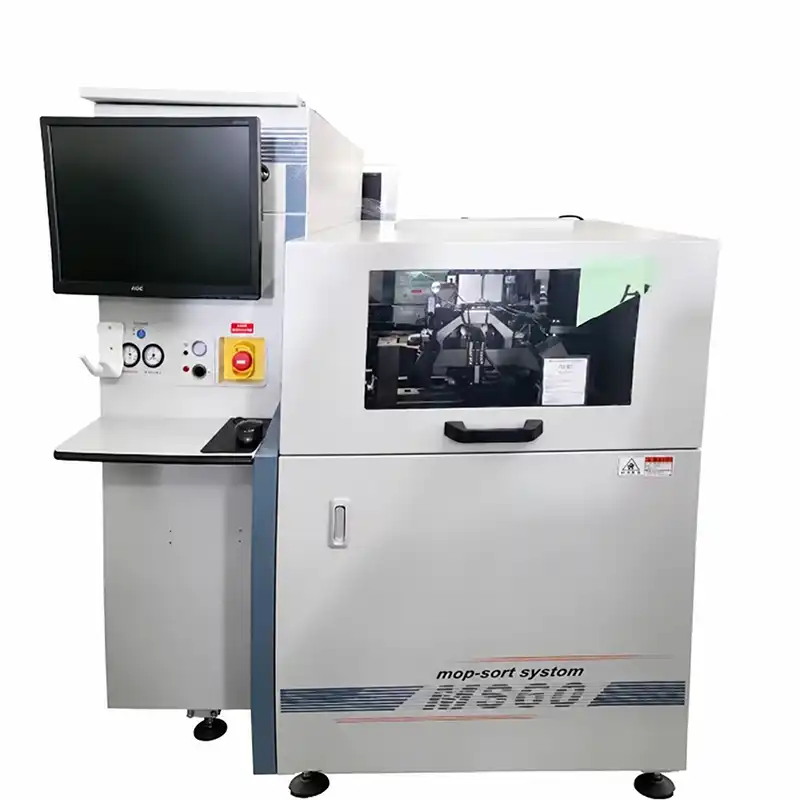
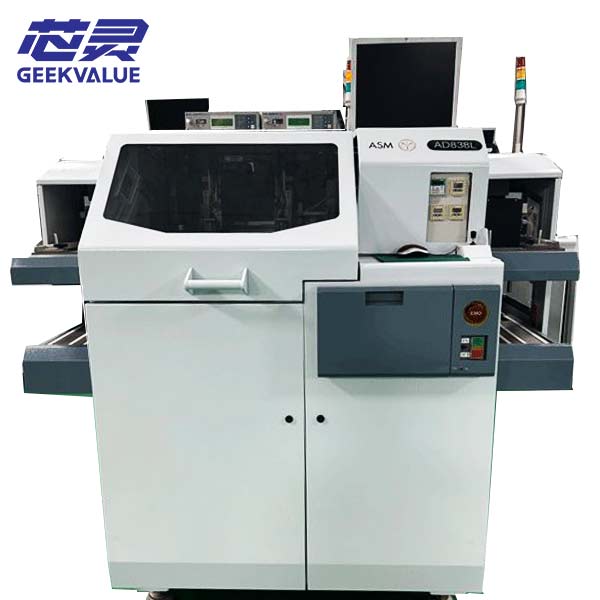
The ASM MS100 Plus is an upgraded wafer-mapping die sorter and placer, building on the MS100 platform with improved speed, handling stability, and processing capacity. It reads pass/fail and grade data from front-end test mapping files, then picks dies from diced wafers or film frames and places them into designated output positions by category.
The platform handles wafers from 2 to 6 inches, with 2–4 inches as the standard configuration. Output can be routed to carriers, frames, trays, or tubes, depending on the installed output module. Published throughput reaches up to 100 pickup cycles per minute — approximately 6,000 UPH — with die rotation held within ±1°. A dual independent connector system supports single or dual-needle configurations, and an integrated vision system performs dual-alignment verification before each placement.
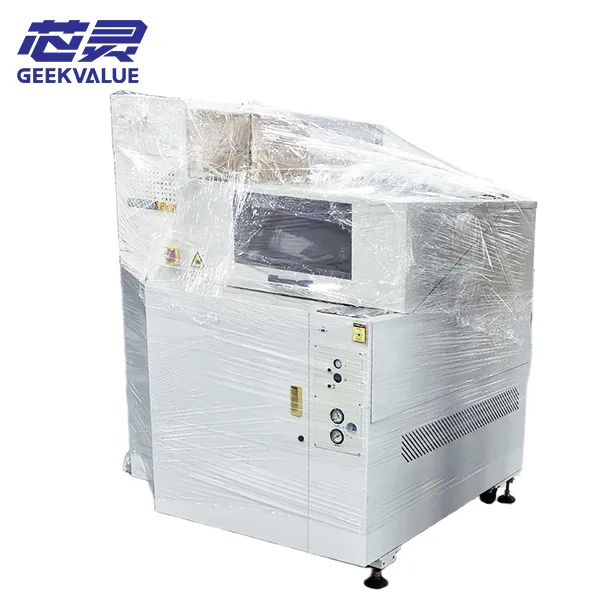
Because the MS100 Plus is a configurable platform, two units under the same model name can carry different pickup tooling, wafer tables, output carriers, and software licenses. The sections below cover the platform's technical capabilities first, followed by configuration and procurement considerations for used units.
Key Specifications
| Parameter | Specification |
|---|---|
| Equipment Type | Wafer mapping die sorter / chip sorter |
| Pickup Cycle | Up to 100 cycles/min (6,000 UPH) |
| Die Rotation Accuracy | ±1° |
| Placement Accuracy | ±1 mil (average) |
| Wafer / Film Frame Size | 2–6 inches (2–4 inches standard, up to 6 inches) |
| Extended Wafer Support | Up to 8-inch eutectic wafers (with height-adjustable bracket) |
| Bond Force Range | 40g – 250g |
| Output Media | Carriers, frames, trays, tubes |
| Connector Configuration | Dual independent connectors; single-needle or dual-needle |
| Program Storage | Up to 200 program files |
| Power Consumption | 1300W (110VAC) |
| Input Voltage | 100–240 VAC, 50/60Hz |
| Compressed Air Requirement | 87 PSI (6 bar) |
| Compressed Air Consumption | 155 LPM |
| Frame Construction | High-strength steel frame with rubber vibration-damping mounts |
Configuration & Procurement Notes
The MS100 Plus is a configurable platform. Two units carrying the same model name can have different pickup tooling, wafer table sizes, output carrier modules, and software license levels. If you're evaluating a used unit, these are the items that determine whether it will actually run your product:
Wafer/frame format. Confirm the installed wafer table and frame adapter match your wafer size and film frame dimensions. Standard configuration handles 2–4 inches; 6-inch and 8-inch support requires specific hardware.
Pickup tooling. Check which nozzle and needle sets are included. Tooling is die-size-dependent — a setup optimized for 0.3mm dies won't work for 2mm dies without changing the tooling.
Output module. Carriers, frames, trays, and tubes each require a different output module. Make sure the unit ships with the module that matches your downstream packaging.
Software version and licenses. Map file format compatibility, program storage capacity, and any optional sorting algorithms may be version-dependent.
Vision system calibration. Request the calibration record and verify the vision alignment accuracy on a sample wafer if possible.
Service history. For high-cycle equipment, ask about the die-cutting head's service life, belt/feeder replacement history, and any servo motor maintenance records.