Choosing between used ASMPT and BESI die bonders is not simply a matter of deciding which brand is better. The more important question is whether a specific machine can perform the required bonding process, handle the target product, and meet production requirements without excessive modification or integration costs.
A machine used for conventional epoxy die attach may not be suitable for flip-chip assembly. High-precision chip-on-substrate bonding brings another set of requirements, particularly when alignment, substrate geometry, and bonding conditions affect the final product.
For buyers comparing used semiconductor equipment, starting with the application helps narrow the model selection before price and availability enter the discussion.
Which Bonding Process Does Your Production Require?
The first step is to identify the actual bonding process. This determines which models deserve further consideration and which comparisons are unlikely to be useful.
Conventional epoxy die attach
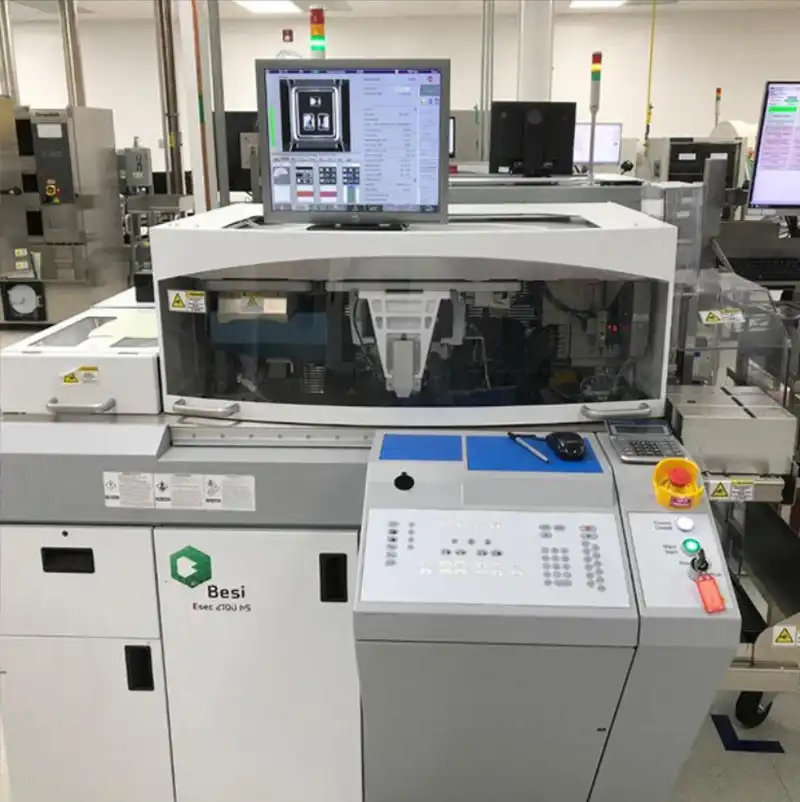
For semiconductor packaging that relies on epoxy die attach, the BESI Esec 2100 hS is one model worth evaluating. Its application range includes package types such as QFN, QFP, BGA, CSP-BGA, and LGA.
In this production environment, the decision involves more than placement speed. Adhesive dispensing, die handling, substrate compatibility, process consistency, and product changeover all affect the machine's practical value.
A used Esec 2100 hS should therefore be checked against the target package and production flow. Buyers need to confirm that the required dispensing, vision, die handling, and automation options are present on the actual machine.
ASMPT alternatives may also be worth considering where their process capabilities match the same production requirements. The comparison should be based on the intended application rather than the assumption that every machine from either manufacturer is interchangeable.
Flip-chip bonding
Flip-chip assembly requires a different evaluation. Die orientation, alignment, bonding conditions, substrate format, and the required process options become central to the selection.
The BESI Esec 2100 FC hS is a relevant candidate for flip-chip applications. ASMPT also offers platforms for advanced and precision die bonding, but the appropriate model depends on the specific assembly process.
A buyer should not compare the Esec 2100 FC hS with a conventional epoxy die bonder solely because both machines place semiconductor dies. Their process requirements may be substantially different.
Before shortlisting a used flip-chip bonder, confirm the required bonding method, supported die and substrate dimensions, handling configuration, vision functions, and any necessary flux or heating options.
High-precision chip-on-substrate assembly
When die placement accuracy is critical, ASMPT AMICRA CoS is a model worth investigating. Its application focus includes high-precision chip-on-substrate and chip-on-submount assembly, with bonding options that may include eutectic bonding and epoxy stamping, depending on configuration.
These requirements can arise in photonics, optical communications, and other advanced semiconductor assembly applications. Here, placement performance is only one part of the evaluation. The bonding method, substrate geometry, heating configuration, and material compatibility must also match the product.
For a used AMICRA CoS, buyers should verify the installed options and the capabilities of the specific unit rather than assuming that every machine includes every function described in the original product literature.
Comparing Used ASMPT and BESI Models
Once the process is clear, the model comparison becomes more meaningful. The following shortlist identifies relevant starting points rather than suggesting that the machines are direct equivalents.
| Production requirement | Models to investigate | Key selection question |
|---|---|---|
| Conventional epoxy die attach | BESI Esec 2100 hS; suitable ASMPT alternatives | Does the configuration support the target package, dispensing process, and output requirements? |
| Flip-chip assembly | BESI Esec 2100 FC hS; suitable ASMPT flip-chip platforms | Can the machine meet the bonding, alignment, and substrate-handling requirements? |
| High-precision chip-on-substrate bonding | ASMPT AMICRA CoS; other suitable precision platforms | Do the placement capability, bonding method, and installed options match the application? |
The model name is only the starting point. A useful comparison should establish what each machine can do in its current configuration and whether that capability matches the intended production process.
If two shortlisted machines target different bonding methods or product requirements, comparing them on purchase price alone is unlikely to produce a reliable decision.
What Matters When Evaluating a Used Machine?
Original specifications can help buyers identify potential candidates, but a used machine must be evaluated as an actual piece of equipment—not simply as a model listed in a product catalogue.
Two machines carrying the same model designation may differ in installed options, tooling, software, condition, and maintenance history. Those differences can affect both process capability and the work required before production begins.
As a semiconductor equipment manufacturer and supplier of used die bonder machines, GK-SEMI can help buyers identify equipment that matches their intended application and review the available configuration information.
Before proceeding with a purchase, establish the following:
Process compatibility: Does the machine support the required epoxy, eutectic, or flip-chip bonding process?
Product dimensions: Are the target die size, substrate dimensions, and package format supported?
Installed options: Are the required vision, dispensing, heating, handling, and automation modules included?
Condition and testing: What operating records, inspection information, and functional demonstrations are available?
Integration requirements: Will the machine need additional tooling, software work, factory interfaces, or process qualification?
Maintenance support: Are critical spare parts and suitable technical support available?
These checks help buyers distinguish a machine that appears suitable on paper from one that has a realistic path to production.
How Much Does a Used ASMPT or BESI Die Bonder Cost?
There is no single price that applies to all used ASMPT or BESI die bonders. The model, manufacturing year, installed options, equipment condition, included accessories, and level of refurbishment can all affect the asking price.
The purchase price should also be considered alongside installation, transportation, commissioning, tooling, maintenance, and process qualification. A machine offered at a lower price may require additional investment if important options are missing or its configuration does not match the production line.
For a meaningful quotation, buyers should specify the required bonding process, target products, die and substrate dimensions, production requirements, and any essential options. This makes it easier to compare machines on a like-for-like basis.
Rather than choosing the lowest-priced unit automatically, evaluate the total cost of bringing the equipment into the intended production environment.
Frequently Asked Questions
1. Is ASMPT better than BESI for die bonding?
Neither manufacturer is universally better for every die bonding application. BESI offers platforms for conventional epoxy die attach and flip-chip assembly, while ASMPT's portfolio includes precision die bonding and advanced packaging solutions. The better choice depends on the required process, placement performance, production volume, and the configuration of the specific machine.
2. What is the difference between the BESI Esec 2100 hS and Esec 2100 FC hS?
The Esec 2100 hS is associated with high-speed epoxy die attach, while the Esec 2100 FC hS targets flip-chip bonding applications. Buyers should first determine which bonding process their product requires, then compare the relevant specifications and installed options.
3. Is the ASMPT AMICRA CoS suitable for conventional die attach?
The AMICRA CoS is primarily relevant to high-precision chip-on-substrate and chip-on-submount assembly. Certain configurations may support bonding approaches such as eutectic bonding or epoxy stamping. Suitability for a particular application depends on the required process and the options installed on the machine.
4. What specifications should I compare when buying a used die bonder?
Start with the bonding method, die and substrate dimensions, placement requirements, production throughput, and supported materials. Then verify the installed vision, dispensing, heating, handling, and automation options. Equipment condition, maintenance history, spare-parts availability, and integration requirements should also be reviewed before purchase.
5. How much does a used ASMPT or BESI die bonder cost?
The price varies by model, age, configuration, condition, and included accessories. Refurbishment and after-sales support may also affect the quotation. Request pricing for a specific machine with a clearly documented configuration, then compare the total cost of installation and production readiness rather than the equipment price alone.
6. Where can I buy a used ASMPT or BESI die bonder?
Used semiconductor equipment suppliers such as GK-SEMI can be contacted to inquire about available models and application requirements. Before purchasing, confirm the actual machine configuration, condition, included options, and available testing documentation. Current stock and machine specifications should be verified directly with the supplier.
Choosing the Right Used Die Bonder
The right choice between ASMPT and BESI depends on the job the machine needs to perform. Conventional epoxy die attach, flip-chip bonding, and high-precision chip-on-substrate assembly each call for different selection criteria.
Start by defining the bonding process and product requirements. Use those requirements to narrow the model shortlist, then verify the installed configuration, equipment condition, and total cost of bringing the machine into production.
A suitable used die bonder is one that matches the required process, has a verified configuration, and offers a practical route to stable production—not simply the one with the lowest price or the more familiar brand name.